Quick answer: Early direct deposit means your bank makes your paycheck available as soon as it learns the payment is coming, instead of waiting for the official payday. That’s usually up to two days early. It’s free at many banks and apps, but it isn’t guaranteed: the timing depends on when your employer or other payer sends the payment.
Key takeaways
- Your employer sends payroll to the banking system a day or two before payday. Banks offering early direct deposit release the money when that notice arrives.
- Capital One, Chime, Varo, SoFi, Current and Chase Secure Banking all advertise paychecks up to two days early, as of November 2026.
- It’s not a loan and it doesn’t cost extra at these providers. It simply moves your normal pay forward.
- Your first paycheck, holiday weeks and some types of payments may arrive on the regular date instead.
How does early direct deposit work?
Direct deposit runs on the ACH network, which Nacha says is how nearly 96% of American workers get paid. Your employer, or its payroll company, sends a payment file ahead of payday with a settlement date attached, which is the day the money officially moves between banks.
A traditional bank waits for that settlement date before showing the funds in your account. A bank with early direct deposit doesn’t. Chime describes it as making the funds available on the day the payment file is received. Capital One says it often gets a message up to two days before the deposit, letting it know the money is on the way. SoFi says it releases funds based on the notice of an impending payment it receives through the Federal Reserve.
Here’s a typical timeline. Say your official payday is Friday. Your payroll company submits the file on Wednesday with a Friday settlement date. A traditional bank posts the money Friday morning. A bank with early direct deposit can post it Wednesday, as soon as the file arrives. If payroll goes out Thursday instead, you’d get it Thursday, one day early.
In other words, nothing about your paycheck changes. The bank simply decides to trust the incoming payment and let you use it sooner.
Banks and apps that offer early direct deposit
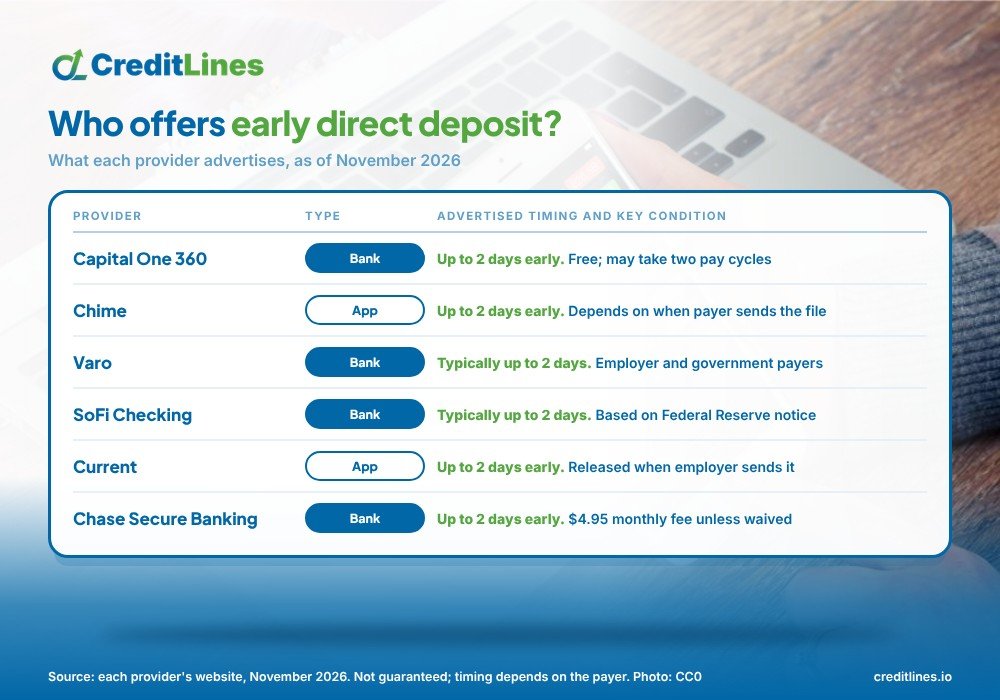
Here’s what the bigger names advertise as of November 2026. Wording, conditions and fees come from each provider’s own website.
| Provider | Bank or app? | What it advertises | Notable conditions |
|---|---|---|---|
| Capital One 360 Checking | Bank (Capital One, N.A.) | Paycheck up to two days early | Free; covers salary, pension and government benefits; may take two pay cycles to start |
| Chime | App; banking by The Bancorp Bank or Stride Bank | Direct deposit up to 2 days early | Depends on when the payer sends the file; weekdays only |
| Varo | Bank (Varo Bank, N.A.) | Typically up to 2 days early | Employer and government payers |
| SoFi Checking | Bank (SoFi Bank, N.A.) | Typically up to two days before payday | Based on notice through the Federal Reserve; may vary |
| Current | App; banking by Cross River Bank | Payday up to 2 days early | Released as soon as the employer sends it |
| Chase Secure Banking | Bank (JPMorgan Chase) | Paycheck up to 2 days early | $4.95 monthly fee unless waived; $0 for ages 17 to 24 |
Two of these, Chime and Current, are financial technology companies rather than banks, so your money is held at a partner bank. That’s a common setup, and our guide to online banks and fintech apps explains how FDIC coverage works when an app sits in the middle.
If you’d like early pay at a traditional bank with branches, Capital One is one of the few big banks that offers it for free. Our Capital One 360 review covers the rest of the account.
Why your paycheck sometimes isn’t early
Every provider in the table uses the words “up to” or “typically” for a reason. Your money can land on the normal payday, or one day early instead of two, when:
- Your employer sends payroll late. If the file reaches the bank the night before payday, there’s no early window to give you. This is the most common reason.
- It’s a holiday or weekend week. Chime, for example, processes early deposits Monday through Friday only, and bank holidays push things back.
- It’s your first deposit. Capital One notes it may take two pay cycles before early paycheck kicks in.
- The payment type isn’t eligible. Capital One excludes certain non-payroll and tax payments, so a tax refund or a transfer from a payment app may arrive on its normal schedule.
- You changed jobs or payroll providers. A new payer can mean new timing.
Because of this, don’t schedule a rent payment or loan autopay for two days before payday on the assumption the money will be there. Give yourself the normal payday as your planning date, and treat any early arrival as a bonus.
Early direct deposit vs. paycheck advances
It’s easy to mix these up, since apps often market them side by side. They’re different products.
| Early direct deposit | Paycheck advance or cash advance app | |
|---|---|---|
| Whose money is it? | Your own pay, released sooner | Money advanced to you against future pay |
| Cost | Free at the providers above | Often fees, “tips” or charges for instant transfers |
| Repayment | None | Taken out of your next paycheck |
| Timing | Up to 2 days early, not guaranteed | Can arrive immediately |
If you keep running short in the two days before payday, early direct deposit is the cheapest fix there is. It’s far better than a payday loan, which charges steep fees to cover the same short gap. The catch is that it only works once. After your first early paycheck, the next one is also early, so the gap moves with you rather than disappearing.
How to set up early direct deposit
- Open a checking account that offers it. Early pay is usually tied to checking, not savings. Capital One, for example, doesn’t offer it on savings accounts.
- Get your account and routing numbers. Most apps show them right after you open the account, and many can generate a pre-filled direct deposit form.
- Update direct deposit with your employer. Do it through your HR or payroll portal, or hand in the form. For Social Security or other benefits, update your deposit details with the agency that pays you.
- Turn the feature on if needed. Some banks enable it automatically. Capital One lets you switch early paycheck on or off in its app.
- Watch the first two paydays. Note when the money actually lands, so you know your real timing.
How to make early pay actually help your budget
Getting paid early once is nice. Getting your bills to line up with it is what makes a difference month after month.
- Move due dates, not just paydays. Many card issuers and utilities let you pick your due date. Set big bills for a few days after your usual payday, so even a late deposit covers them.
- Build a one-paycheck buffer over time. Leaving even a few hundred dollars untouched in checking means a late payroll file never turns into an overdraft.
- Automate savings for the day the money lands. If your deposit arrives Wednesday, schedule your savings transfer for Wednesday too, before the money gets spent.
- Turn on balance alerts. A text when your paycheck posts, or when your balance drops below a set amount, takes the guesswork out of the timing.
None of this requires a new bank. If your current account doesn’t offer early direct deposit, these habits still smooth out the days before payday.
Is it worth switching banks for?
On its own, two days of earlier access is a small perk. It’s most useful if your budget is tight around payday, or if bills and paydays don’t line up well. If that’s you, early direct deposit can save you from overdrafts and short-term borrowing without costing anything.
If you already have a healthy buffer in checking, it matters much less than the account’s fees, ATM access, overdraft policy and savings rate. Choose the account that’s best on those, and count early pay as a tiebreaker.
Who might skip it: anyone who relies on a branch for cash deposits, since several of the app-based options charge for cash deposits or out-of-network ATM use. Check the fee schedule before you move your paycheck.
Frequently asked questions
Is early direct deposit safe?
Yes. It’s your own paycheck, released by your bank before the official settlement date, not a loan. The money sits in an FDIC-insured account at the bank or the app’s partner bank, the same as any other deposit. The only real risk is planning around it: since timing isn’t guaranteed, don’t set bills to come out two days before payday.
Why didn’t my paycheck come early this time?
Usually because your employer or payroll company sent the payment later than normal, or because a weekend or bank holiday shifted the schedule. New accounts can also take a pay cycle or two before early deposits start. If it keeps happening, ask your payroll department when it submits direct deposits.
Can Social Security benefits come early with direct deposit?
Some banks include government benefits in their early deposit programs. Capital One, for example, says pension and government benefits are eligible, and Varo covers government payers. Whether a specific benefit payment arrives early still depends on when the payment notice reaches your bank, so check your bank’s terms.
Does early direct deposit cost anything?
Not at the providers covered here. Capital One, Chime, Varo, SoFi and Current all present it as a free feature of their checking accounts. Some accounts have other costs, such as Chase Secure Banking’s monthly fee unless waived, or fees for out-of-network ATMs and cash deposits at app-based providers, so look at the whole fee schedule.
Can I get early direct deposit from my current bank?
Possibly. Many traditional banks still release pay on the official payday, but a growing number offer early access on some checking accounts. Search your bank’s website or app for terms like early pay or early paycheck. If it doesn’t offer it, you can split your direct deposit and send part of each paycheck to an account that does.
Sources
- Nacha, Direct Deposit
- Chime, Get paid early (disclosures)
- Capital One, Early paycheck
- Varo, Early direct deposit
- SoFi, Banking (early direct deposit disclosure)
- Current, Payday up to 2 days early
- Chase, Checking accounts (Chase Secure Banking)
This article is for educational purposes only and is not financial advice. Features and fees change, so confirm details with the bank or app before you switch.