
Quick answer: Fireblocks, often typed as “Fireblock,” is an institutional crypto security and custody infrastructure platform, not a consumer wallet or exchange. It uses a technology called multi-party computation (MPC) to split a private key into encrypted fragments spread across separate secure environments, so no single person or device can move funds alone, which eliminates the single point of failure that plagues traditional crypto wallets. Over 2,000 institutions, including major banks, use Fireblocks to secure trillions of dollars in digital asset transfers. Individuals cannot sign up for it directly, but you benefit from it whenever an exchange or app you use is built on it. It is a legitimate, well-regarded platform, but scammers sometimes misuse its trusted name.
If you have researched crypto security, you have probably run into the name Fireblocks, maybe as the technology quietly protecting your exchange, or maybe in a pitch that sounded a little too good. Because it is a trusted institutional name, it is worth understanding exactly what Fireblocks is, what it is not, and how to make sure a “Fireblocks” claim you encounter is the real thing. This guide explains all of it in plain English.
What is Fireblocks?
Fireblocks is an enterprise digital asset infrastructure platform. It gives banks, exchanges, fintechs, and other organizations the tools to securely store, transfer, settle, and manage cryptocurrencies and other digital assets. Founded in 2018 and headquartered in New York, it has become one of the most trusted names in institutional crypto security.
The most important thing to understand is what Fireblocks is not. It is not a consumer wallet you download, and it is not a crypto exchange where you buy coins. It is behind-the-scenes infrastructure, the plumbing that lets large organizations handle digital assets safely. In fact, Fireblocks describes itself as providing the wallet and security technology rather than acting as a custodian itself, meaning its clients use its tools to control their own assets or their customers’ assets.
How does Fireblocks secure crypto? MPC explained
At the heart of Fireblocks is multi-party computation, or MPC, and understanding it explains why the platform is considered so secure.
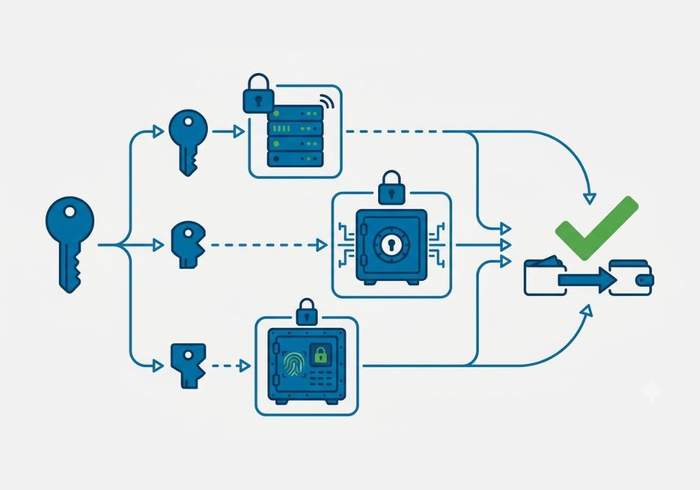
Every crypto wallet is controlled by a private key, a secret number that authorizes transactions. Whoever holds that key controls the funds, which makes protecting it the central challenge of crypto security. A traditional wallet stores the whole key in one place, creating a single point of failure: if that key is stolen, the funds are gone.
MPC solves this by never keeping the key whole. Instead, it splits the private key into multiple encrypted fragments and distributes them across different secure environments. To approve a transaction, several of those fragments must work together, but the complete key is never assembled in any single location or held by any single person or device. The result is security comparable to keeping assets in offline cold storage, since the full key is never exposed online, while still allowing the speed and flexibility that businesses need to operate. Fireblocks uses its own advanced implementation of this technology, known as MPC-CMP.
Here is how MPC compares to other ways institutions have secured keys:
| Security method | How it works | Main limitation |
|---|---|---|
| Single private key | One key controls all the funds | A single point of failure if stolen |
| Multi-signature | Several separate keys must approve a transaction | Less flexible and often chain-specific |
| Hardware security module | The key is stored in dedicated physical hardware | Costly and less operationally flexible |
| MPC (used by Fireblocks) | The key is split into fragments across environments | Complex, designed for organizations |
Beyond MPC: policy controls and the network
Fireblocks pairs its MPC security with two other important layers. A policy engine lets an organization set rules about who can approve and move funds, with limits and multi-person approvals, which helps prevent fraud, internal misuse, and costly mistakes. And the Fireblocks Network provides a secure connectivity layer for institutions to transfer and settle assets between each other, with protections against tricks like deposit-address spoofing, where an attacker swaps in their own wallet address. Together, security, governance, and connectivity make it a full operating system for institutional digital assets.
Who uses Fireblocks?
Fireblocks is used by more than 2,000 organizations, including dozens of banks running it in live production. Its clients span major banks, neobanks and fintechs, crypto exchanges, hedge funds, market makers, and corporate treasuries. Large, regulated financial institutions have adopted it, which is a strong signal of its credibility.
The practical takeaway for everyday users is that Fireblocks is often the invisible infrastructure behind services you already use. When you buy or hold crypto through a major exchange or a fintech app, there is a real chance the security protecting those assets runs on Fireblocks, even though you never interact with it directly.
Can individuals use Fireblocks?
For most people, this is the key question, and the answer is no, not directly. Fireblocks is built for organizations, not individual retail users. You cannot simply sign up as a person and open a personal Fireblocks wallet.
Instead, individuals benefit from it indirectly, through the exchanges, apps, and platforms that are built on it. If you are an individual who wants the kind of self-custody security that MPC provides, the consumer path is different: you would use a reputable consumer crypto wallet, some of which use similar MPC technology, or a hardware wallet for cold storage. This distinction matters, because it is also the basis of a common scam, which we will cover next.
Is Fireblocks safe and legitimate?
Yes. Fireblocks is a legitimate, well-established company and one of the most respected names in institutional crypto security. It reports zero security breaches since its founding, secures trillions of dollars in transfers, and is trusted by regulated banks and major financial institutions, which subject any vendor to heavy due diligence. Its MPC-based approach is widely regarded as an industry security standard.
None of that guarantees any specific outcome, and no security system is ever completely risk-free. But as institutional infrastructure goes, Fireblocks has a strong track record and a serious reputation.
Fireblocks and scams: how to protect yourself
Here is where the security category matters most. Precisely because Fireblocks is a trusted name, scammers sometimes misuse it to appear legitimate. Being aware of a few patterns can protect you:
- There is no consumer “Fireblocks token” or “Fireblock coin.” If anyone pitches you a Fireblocks-branded token to buy, treat it as a scam. Fireblocks is infrastructure, not a coin you invest in.
- Be skeptical of anyone name-dropping Fireblocks to sell to individuals. Since the platform is for organizations, a stranger telling a regular person to “deposit to Fireblocks” or claiming a personal investment is “secured by Fireblocks” is a red flag.
- Watch for phishing sites and fake apps. Scammers copy trusted brands to steal logins and funds. Verify you are on the official domain and never enter wallet credentials into a site you reached through a message or ad.
- Legitimacy claims are not verification. A platform saying it uses Fireblocks does not automatically make it safe. Research the platform itself independently.
When in doubt, remember the simple rule: Fireblocks sells to businesses, not to individuals, so any individual-facing “opportunity” using its name deserves extra scrutiny.
What Fireblocks teaches everyday crypto users
Even if you never touch Fireblocks directly, its approach highlights security principles you can apply:
- Eliminate single points of failure. Do not keep everything behind one password or one key. Hardware wallets and reputable MPC-based consumer wallets spread out that risk.
- Use multi-step approvals for large amounts, even if that just means extra verification steps you enable.
- Choose reputable, well-secured platforms for the crypto you do not self-custody.
- Stay alert to phishing, which remains the most common way individuals lose funds.
Frequently asked questions
What is Fireblocks in crypto?
Fireblocks is an institutional digital asset infrastructure platform that provides secure custody, transfer, and management of cryptocurrencies for organizations like banks, exchanges, and fintechs. It is not a consumer wallet or exchange, and it uses multi-party computation to protect private keys.
Is Fireblocks the same as “Fireblock”?
Yes. “Fireblock” is a common misspelling of Fireblocks. There is one company, Fireblocks, and no separate product called Fireblock. If you see a “Fireblock coin” or token, be cautious, as it is not an official Fireblocks product.
How does Fireblocks keep crypto secure?
It uses multi-party computation, which splits a private key into encrypted fragments stored across separate secure environments. No single person or device can move funds alone, and the full key is never assembled in one place, eliminating the single point of failure of a traditional wallet.
Can individuals use Fireblocks?
No, not directly. Fireblocks is built for organizations, not retail users. Individuals benefit from it indirectly when the exchanges or apps they use are built on it. For personal self-custody, consumer MPC wallets or hardware wallets are the alternatives.
Is Fireblocks safe and legitimate?
Yes. Fireblocks is a legitimate, well-established company trusted by major banks and financial institutions, with a strong security track record and no reported breaches since its founding. Its MPC technology is considered an industry security standard, though no system is entirely risk-free.
Is there a Fireblocks token to invest in?
No. Fireblocks is infrastructure, not a cryptocurrency, and it does not have a public consumer token. Anyone offering you a Fireblocks or Fireblock token to buy is almost certainly running a scam, so avoid it.
Who uses Fireblocks?
More than 2,000 organizations use Fireblocks, including major banks, neobanks and fintechs, crypto exchanges, hedge funds, and corporate treasuries. It often serves as the behind-the-scenes security infrastructure for consumer crypto services.
This article is for educational and informational purposes only and is not financial, investment, or security advice, and it is not affiliated with or endorsed by Fireblocks. Company details, figures, and features change over time. Always verify platforms independently through official sources, and be cautious of anyone using a trusted brand’s name to solicit individual investments.

This Post Has One Comment