
Quick answer: As of August 2026, the top 10 cryptocurrencies by market capitalization are led by Bitcoin, worth around $1.4 trillion, and Ethereum, worth around $275 billion, which together make up roughly 71% of the entire crypto market. The rest of the top 10 typically includes XRP, BNB, Solana, Dogecoin, Cardano, TRON, Chainlink, and Avalanche, though the positions below the top two rotate frequently. Stablecoins like Tether (USDT) and USD Coin (USDC) also rank near the top by raw market cap but are usually listed separately since they are pegged to the dollar. Rankings change constantly, so treat any list as a snapshot, and remember that market cap size is not a measure of whether a coin is a good investment.
With more than 18,000 cryptocurrencies in existence, the top 10 by market cap are the largest, most established, and most closely watched. They are where most investors start and where the vast majority of the market’s value sits. This guide breaks down the top 10 cryptocurrencies in 2026, explains what each one actually does, shows how the rankings work, and covers what to understand before putting money into any of them.
How the top 10 is ranked
Cryptocurrencies are ranked by market capitalization, which is simply the current price of a coin multiplied by its circulating supply. A coin trading at $2 with one billion coins in circulation has a $2 billion market cap. Market cap is the standard because it reflects the total value the market places on a project, which is more meaningful than price alone.
Analysts group coins into tiers: large-cap coins worth more than $10 billion, which are seen as more established and less volatile; mid-cap coins between $1 billion and $10 billion, with higher growth potential and higher risk; and small-cap coins under $1 billion, which can be highly speculative. The entire top 10 sits firmly in large-cap territory.
One important caveat: the composition of the top 10 shifts. Bitcoin and Ethereum have held the top two spots consistently, but analysts note that one to three positions in the lower half of the top 10 typically rotate within any 12-to-24-month window as newer projects gain traction.
The crypto market in 2026
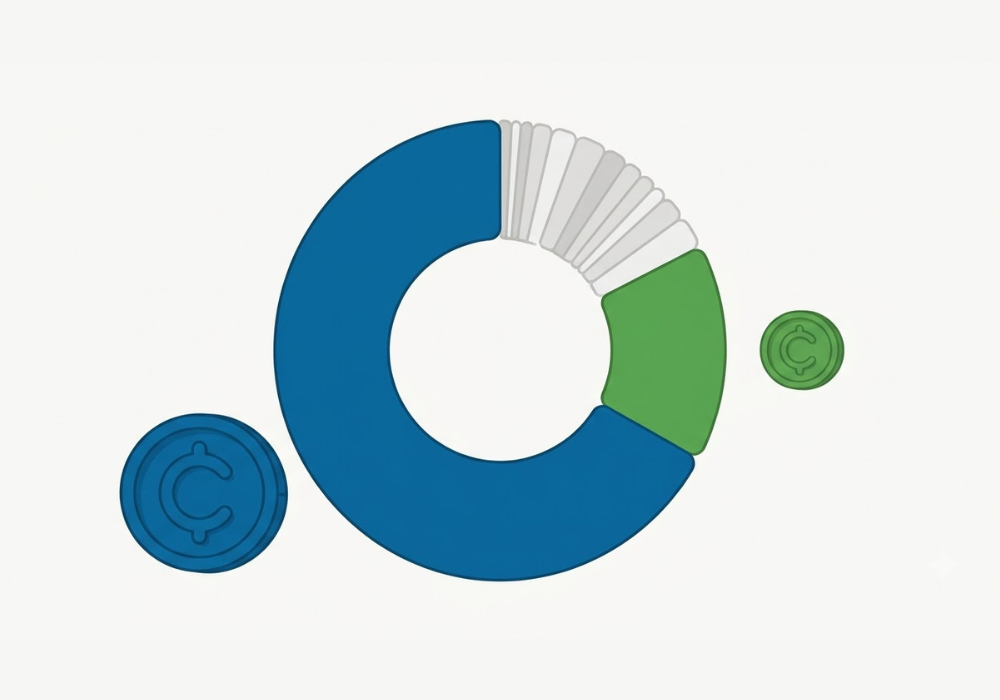
The market has matured. Total cryptocurrency market capitalization sits around $2.6 trillion as of August 2026, and Bitcoin alone accounts for well over half of it, with Bitcoin dominance around 57% to 59%. A major theme of this cycle is institutional adoption, driven by spot Bitcoin and Ethereum exchange-traded funds that brought traditional investment money into the market. Prices have swung sharply throughout the year, a reminder that even the largest coins remain volatile.
The top 10 cryptocurrencies in 2026
Here are the ten largest cryptocurrencies by market cap as of August 2026, excluding stablecoins. Because rankings below the top two rotate, treat the exact order as a snapshot and check a live source like CoinGecko or CoinMarketCap for current standings.
| Rank | Cryptocurrency | What it does |
|---|---|---|
| 1 | Bitcoin (BTC) | Digital gold and store of value, the original crypto and largest by far |
| 2 | Ethereum (ETH) | Smart-contract platform powering DeFi, NFTs, and most Web3 apps |
| 3 | XRP | Fast, low-cost cross-border payments and settlement |
| 4 | BNB | Powers the BNB Chain and the broader Binance ecosystem |
| 5 | Solana (SOL) | High-speed, low-cost smart-contract blockchain |
| 6 | Dogecoin (DOGE) | The original meme coin, used for tips and payments |
| 7 | Cardano (ADA) | Research-driven proof-of-stake smart-contract platform |
| 8 | TRON (TRX) | High-throughput chain widely used for stablecoin transfers |
| 9 | Chainlink (LINK) | Oracle network feeding real-world data to blockchains |
| 10 | Avalanche (AVAX) | Fast-finality smart-contract platform with custom subnets |
1. Bitcoin (BTC)
Bitcoin is the original cryptocurrency and remains the largest by a wide margin, worth around $1.4 trillion. Often called digital gold, it is valued mainly as a decentralized store of value and a hedge, with a fixed supply capped at 21 million coins. The launch of spot Bitcoin ETFs opened the door to institutional money, cementing its position at the top. For most newcomers, Bitcoin is the starting point for understanding crypto.
2. Ethereum (ETH)
Ethereum is the second-largest cryptocurrency, worth around $275 billion, and the most important platform for building on the blockchain. Its breakthrough was the smart contract, self-executing code that powers decentralized finance, NFTs, and most of the applications people call Web3. If Bitcoin is digital gold, Ethereum is the programmable foundation much of the crypto economy is built on. Together, Bitcoin and Ethereum make up roughly 71% of the total market.
3. XRP
XRP, associated with Ripple, is designed for fast and inexpensive cross-border payments and settlement between financial institutions. Its focus on real-world payment utility, and greater regulatory clarity in recent years, has kept it near the top of the rankings.
4. BNB
BNB powers the BNB Chain and the wider ecosystem tied to Binance, one of the world’s largest crypto exchanges. It is used to pay fees, access services, and interact with applications on its chain, giving it steady utility-driven demand.
5. Solana (SOL)
Solana is a high-performance blockchain known for very fast, low-cost transactions, which has made it a hub for DeFi, meme-coin trading, and consumer applications. It is often described as the leading infrastructure competitor to Ethereum, and it tends to rise when on-chain activity increases.
6. Dogecoin (DOGE)
Dogecoin began as a joke in 2013 but grew into a top cryptocurrency driven by a large community and celebrity attention. It is used for tips and small payments, and it remains the best-known meme coin, though its value is heavily sentiment-driven.
7. Cardano (ADA)
Cardano is a proof-of-stake smart-contract platform known for its research-driven, peer-reviewed approach to development. It positions itself as a more methodical, academically grounded alternative to other smart-contract chains.
8. TRON (TRX)
TRON is a high-throughput blockchain widely used for transferring stablecoins, particularly for low-cost dollar transfers. It has a large user base for payments and content applications, though it has faced regulatory scrutiny.
9. Chainlink (LINK)
Chainlink is a decentralized oracle network, which means it securely feeds real-world data, like prices and events, to blockchains and smart contracts. Because so many DeFi applications rely on accurate outside data, Chainlink provides critical infrastructure across the industry.
10. Avalanche (AVAX)
Avalanche is a smart-contract platform known for fast transaction finality and the ability to launch custom blockchains called subnets. It competes with Ethereum and Solana and has remained a consistent presence in the top 10 throughout 2026.
A note on stablecoins
If you look at a raw market-cap list, you will see Tether (USDT) and USD Coin (USDC) ranked among the very largest cryptocurrencies. These are stablecoins, pegged to the U.S. dollar to hold a steady value near $1. Their large market caps come from utility and settlement demand rather than price growth, so most “top 10 cryptocurrency” lists treat them separately from coins whose value can rise and fall. They are essential plumbing for trading and transfers, but they are not investments in the sense of appreciating assets.
New entrants and constant rotation
The lower half of the top 10 is a revolving door. In 2026, Hyperliquid (HYPE), a DeFi-native token, broke into the top 10, becoming only the second DeFi-native token in history to do so. Others like Sui (SUI) and Toncoin (TON) have moved in and out of the rankings. This turnover is exactly why any top 10 list is a snapshot in time. The top two are stable, but positions three through ten shift as newer projects gain or lose traction.
Bitcoin and Ethereum: why the two leaders dominate
Bitcoin and Ethereum are often called the gold and silver of crypto, and for good reason. Together they account for roughly 71% of the entire market’s value, dwarfing everything below them. Bitcoin dominates as a store of value, while Ethereum dominates as the platform for building applications. Crypto watchers have long debated a theoretical event called “the flippening,” the point at which Ethereum might overtake Bitcoin in market cap. It has not happened, and whether it ever will remains a matter of debate.
What market cap tells you, and what it doesn’t
A high ranking means a coin is large, liquid, and widely held, which generally means lower risk than a tiny, obscure token. But market cap size is not a measure of quality, safety, or future returns. Large coins still experience dramatic price swings, and being in the top 10 is no guarantee against major losses. Ranking tells you how big something is, not whether it is a good investment for you.
How to research before investing in any crypto
Before buying any cryptocurrency, top 10 or not, do your own homework:
- Understand the use case. What real problem does the project solve, and is anyone actually using it?
- Look at adoption and activity. On-chain activity and real users matter more than hype.
- Check the fundamentals, including the team, the token’s supply and economics, and its track record.
- Consider security and storage, since you will need a safe way to hold and protect your crypto.
- Never invest more than you can afford to lose. Crypto is highly volatile, and even top coins can fall sharply.
Also remember that buying and selling crypto has tax consequences, and how you pay for it matters, so factor those in before you start.
Frequently asked questions
What are the top 10 cryptocurrencies in 2026?
As of August 2026, the top 10 by market cap are led by Bitcoin and Ethereum, followed by a rotating group that typically includes XRP, BNB, Solana, Dogecoin, Cardano, TRON, Chainlink, and Avalanche. Stablecoins like USDT and USDC also rank near the top but are usually listed separately.
How are cryptocurrencies ranked in the top 10?
They are ranked by market capitalization, which is the coin’s price multiplied by its circulating supply. Market cap reflects the total value the market assigns to a project, which is more meaningful than price alone, and the top 10 are all large-cap coins worth over $10 billion.
What is the biggest cryptocurrency?
Bitcoin is the largest cryptocurrency by a wide margin, with a market cap around $1.4 trillion in August 2026, accounting for well over half of the entire crypto market. Ethereum is second at around $275 billion.
Do stablecoins count in the top 10 cryptocurrencies?
By raw market cap, stablecoins like Tether and USD Coin rank among the largest cryptocurrencies. However, because they are pegged to the dollar and do not appreciate in value, most top 10 lists treat them separately from coins whose prices can rise and fall.
Does a high market cap mean a crypto is a good investment?
No. A high ranking means a coin is large, liquid, and widely held, which generally means lower risk than a tiny token, but it is not a measure of quality, safety, or future returns. Even top 10 coins are volatile and can lose value sharply.
How often does the top 10 change?
Bitcoin and Ethereum have held the top two spots consistently, but the lower half rotates often, with one to three positions typically changing within any 12-to-24-month window as newer projects gain traction. Any list is a snapshot in time.
Is Ethereum going to overtake Bitcoin?
This theoretical event, called “the flippening,” has been debated for years but has not happened. Bitcoin remains far larger, and whether Ethereum will ever overtake it in market cap is uncertain and a matter of ongoing debate.
This article is for educational and informational purposes only and is not financial or investment advice, and it is not a recommendation to buy any cryptocurrency. Cryptocurrency is highly volatile and can lose value rapidly, and rankings and prices change constantly, so any figures reflect August 2026. Verify current data on a live source, do your own research, and never invest more than you can afford to lose.
