
Quick answer: A personal loan for debt consolidation works by paying off multiple high interest debts, usually credit cards, with a single new loan that carries one fixed monthly payment and, ideally, a lower interest rate. It’s worth doing when the new loan’s rate is meaningfully lower than your current average credit card rate and you can commit to not running the cards back up. It’s usually not worth it if your credit score only qualifies you for a rate close to what you’re already paying, or if the real problem is spending rather than interest rate.
If you’re carrying a balance across two or three credit cards and watching the minimum payments barely move the needle, you’re dealing with one of the most common financial frustrations in the US right now. Total credit card debt nationally has climbed past $1 trillion, and the average credit card carries an interest rate well above 20%. At that rate, minimum payments can take a decade or more to clear a balance, most of it going to interest rather than principal.
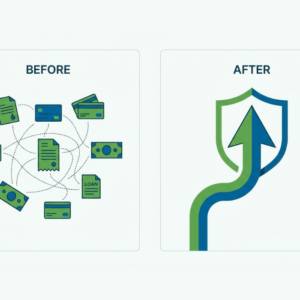
A personal loan is one of the most direct tools built specifically for this problem. Here’s exactly how it works, what it actually costs, and how to tell if it’s the right move for your situation instead of just assuming it is.
How Debt Consolidation With a Personal Loan Actually Works
The mechanics are simple, even if the decision isn’t:
You apply for a personal loan for the total amount of debt you want to pay off.
If approved, the lender deposits the funds into your account, or in some cases pays your creditors directly.
You use that money to pay off your existing credit card balances in full.
You then make one fixed monthly payment to the new lender instead of several different payments to different card issuers, usually over a term of two to five years.
The entire appeal rests on one number: the difference between your current average credit card APR and the APR you qualify for on the personal loan. If that gap is large, consolidation can save real money and shorten your payoff timeline. If the gap is small, consolidation mostly just reorganizes the same debt without meaningfully reducing what you’ll pay overall.
A Real Example of the Math
Say you’re carrying $10,000 in credit card debt at a 22% average interest rate, making a $220 minimum payment. At that rate, it can take well over a decade to pay off, and the total interest paid can end up costing more than the original balance itself.
Now say you qualify for a personal loan at 12% APR over five years. Your fixed monthly payment would land somewhere around $220, similar to what you’re already paying, but the loan would be fully paid off in five years instead of dragging on indefinitely, and total interest paid would be dramatically lower.
This is the actual value of consolidation: not necessarily a lower monthly payment, but a fixed end date and a lower total cost, assuming you qualify for a meaningfully better rate than your current cards.
Who Personal Loan Debt Consolidation Actually Makes Sense For
- You have fair to good credit or better, generally a score in the mid 600s or higher, since this is what typically unlocks a rate low enough to beat your existing card APRs.
- Your debt is driven by a past event, not ongoing overspending, such as a medical bill, a job loss, or a one time expense, rather than a spending pattern that’s still active.
- You want one fixed payment and a fixed end date, rather than the open ended, revolving nature of credit card minimum payments.
- You’re prepared to stop using the paid off cards for new purchases, since running balances back up on top of a new loan payment is how consolidation backfires.
When a Personal Loan Is Not the Right Move
- Your credit score only qualifies you for a rate close to your current cards. If the personal loan APR isn’t meaningfully lower than what you’re already paying, you’re mostly just moving the debt, not improving your situation.
- The debt is driven by ongoing spending, not a one time event. A loan doesn’t fix a spending pattern. Without a changed budget, many people consolidate credit card debt only to rebuild a new balance on the same cards within a year or two.
- You have less than $7,500 to $10,000 in debt. Origination fees and the effort of applying may not be worth it for smaller balances that could be paid down directly or moved to a 0% intro APR balance transfer card instead.
Personal Loan vs. Balance Transfer Credit Card
These two are the most commonly compared options for a reason, they solve a similar problem in different ways:
A balance transfer card typically offers a 0% introductory APR for a limited window, often 12 to 21 months, after which the standard rate applies. This can be cheaper than a personal loan if you’re confident you can pay off the full balance within that introductory window. The tradeoff is a shorter runway and often a balance transfer fee of 3 to 5%.
A personal loan offers a longer, fixed repayment window, typically two to five years, at a fixed rate that doesn’t expire the way a promotional card rate does. This tends to suit larger balances or debt that realistically can’t be paid off within 12 to 21 months.
Step by Step: How to Get Approved
- Check your credit score first, since this single number roughly determines what rate range you’ll actually be offered, before you spend time applying anywhere.
- Get prequalified through a marketplace or lender’s soft pull tool, which shows your likely rate without a hard inquiry or credit score impact, so you can compare real numbers before committing.
- Compare the offered APR against your current average credit card rate, not against the card with the lowest rate in your wallet, since consolidation typically pays off all your cards at once.
- Check for origination fees, which are commonly 1 to 8% of the loan amount and get deducted from what you actually receive, which changes your real cost even if the advertised rate looks attractive.
- Choose direct payment to creditors if the lender offers it, since this removes the temptation to use the funds for something other than paying off the cards.
- Set up autopay immediately, since many lenders offer a small rate discount for it, and it removes the risk of a missed payment early in the loan.
Red Flags to Watch For
- Guaranteed approval regardless of credit history. Legitimate lenders always evaluate credit, income, or both. This claim is a common warning sign of a predatory or fraudulent lender.
- Upfront fees required before funding. A legitimate personal loan deducts fees from the loan proceeds. Being asked to pay a fee out of pocket before receiving funds is a classic advance fee scam pattern.
- Pressure to consolidate debt you could pay off within a year anyway. If your existing debt is small and manageable within 12 months, a 0% intro balance transfer card or simply an aggressive payoff plan may cost you less than a loan with an origination fee attached.
Comparison at a Glance
| Personal Loan | Balance Transfer Card | |
| Typical rate | Fixed, based on credit score | 0% introductory, then standard APR after |
| Best repayment window | 2 to 5 years | 12 to 21 months (during intro period) |
| Fees | Origination fee, often 1 to 8% | Balance transfer fee, often 3 to 5% |
| Best suited for | Larger balances, longer payoff timelines | Smaller balances payable within the intro window |
| Risk if plan fails | Fixed payment continues regardless | Rate jumps sharply once intro period ends |
Frequently Asked Questions
Is a personal loan a good idea for credit card debt?
It can be, if the personal loan’s interest rate is meaningfully lower than your current average credit card rate and you’re prepared to stop adding new balances to the paid off cards. If the rates are similar, or the underlying issue is ongoing overspending, a personal loan mostly reorganizes the debt rather than reducing its true cost.
Does taking out a personal loan hurt your credit score?
There’s often a small, temporary dip from the hard inquiry and the new account, but paying down revolving credit card balances with a fixed installment loan can help your credit utilization ratio, which is a significant factor in your score. Many people see their score recover and even improve within a few months, as long as payments stay on time. If you’re working on rebuilding credit tied to a vehicle loan specifically, refinancing a car loan with bad credit follows a similar improve-then-reapply approach. If your score drops unexpectedly for reasons unrelated to the loan itself, our diagnostic guide on why credit scores drop for no reason walks through the most common causes and how long each one takes to recover from.
How much debt do you need to make a personal loan worth it?
There’s no fixed cutoff, but many financial educators suggest debt consolidation loans start making more sense above roughly $7,500 to $10,000, since origination fees and the application effort are easier to justify against a larger balance than a small one.
Can you get a debt consolidation loan with bad credit?
Yes, though the rate offered may not be low enough to beat your current credit card APR, which is the entire point of consolidating. It’s worth checking your prequalified rate before assuming either that you’ll be rejected or that it will automatically save you money.
What happens if you can’t make payments on a debt consolidation loan?
Most personal loans are unsecured, meaning there’s no collateral like a car or home tied to it, but missed payments still damage your credit score and can eventually be sent to collections or result in a lawsuit for the balance owed. A personal loan should only be taken on with a monthly payment you’re confident you can sustain for the full term.
If you’re a business owner weighing financing options instead of personal debt, our guide on how to get a business loan with bad credit covers a similar decision process for business-specific funding.
Disclaimer: This article is for general educational purposes only and does not constitute personalized financial or legal advice. Loan terms, interest rates, and approval criteria vary by lender and applicant and are not guaranteed. The example figures used are illustrative and not a quote from any specific lender. Consult a qualified financial advisor or a nonprofit credit counselor before making borrowing decisions specific to your situation.

This Post Has 3 Comments