
Quick answer: Comprehensive car insurance covers damage to your vehicle from events other than a collision, such as theft, vandalism, fire, hail and other weather, falling objects, and hitting an animal like a deer. It does not cover crash damage, which is collision coverage, and it does not cover injuries or damage to others, which is liability. Comprehensive is optional under state law but almost always required if you finance or lease your car. It is relatively affordable, averaging around $420 a year in 2026, and comes with a deductible you choose, commonly $250, $500, or $1,000. Whether it is worth it mostly depends on your car’s value.
If a tree branch crushed your hood, your car was stolen from a parking lot, or a deer darted into your path, would you be covered? That is the job of comprehensive car insurance, and the list of what it protects against is broader than most drivers realize. This guide explains exactly what comprehensive covers, what it does not, how it compares to collision, what it costs in 2026, and how to decide whether you need it.
What is comprehensive car insurance?
Comprehensive car insurance is optional coverage that pays to repair or replace your vehicle when it is damaged by something other than a collision. Where collision insurance handles crashes, comprehensive handles almost everything else that can happen to a parked or moving car outside of an accident.
It is important to understand where comprehensive sits in a policy. A typical car insurance policy has several parts: liability, which covers injury and damage you cause to others and is required in most states; collision, which covers crash damage to your own car; and comprehensive, which covers non-crash damage to your own car. Comprehensive and liability protect against completely different things, so most drivers who want full protection carry all three.
What does comprehensive car insurance cover?
The range of covered events is wider than many people expect. Comprehensive typically pays for damage to your car from:
- Theft, including the vehicle being stolen entirely.
- Vandalism, such as keyed paint or broken windows.
- Fire.
- Natural disasters and weather, including hail, floods, hurricanes, and earthquakes.
- Falling objects, like tree branches or debris.
- Animal strikes, such as hitting a deer.
- Riots and civil disturbances.
- Broken glass, like a windshield cracked by a rock on the highway.
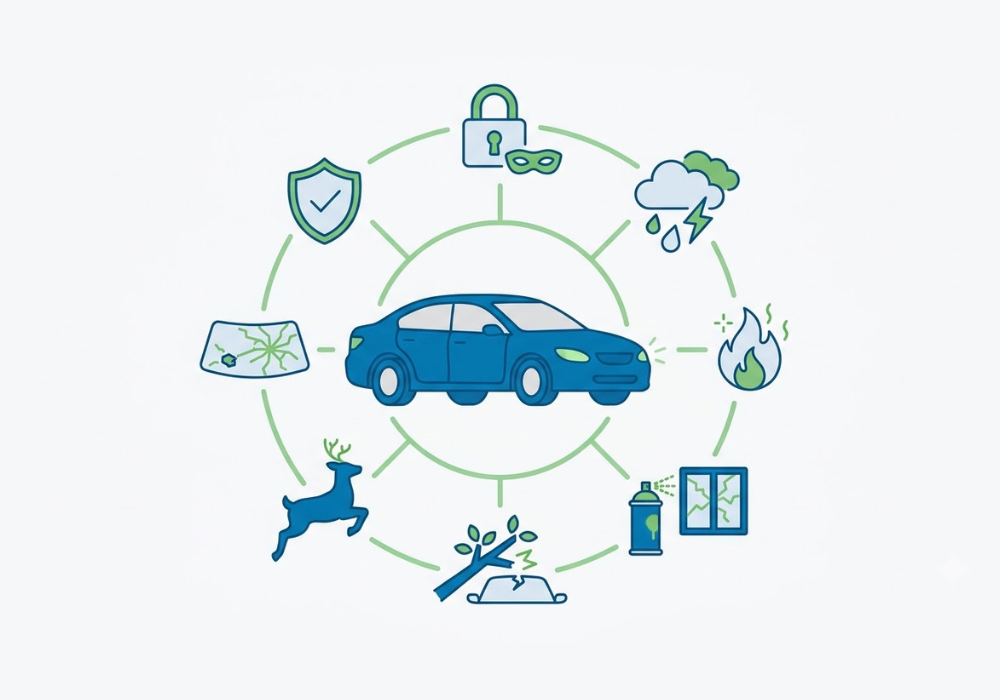
In short, if something damages your car that is not a collision with another vehicle or object you were driving into, comprehensive is usually the coverage that applies. Many insurers also offer glass coverage with a low or zero deductible for windshield repairs.
What comprehensive car insurance does NOT cover
Knowing the limits is just as important. Comprehensive does not cover:
- Collision damage. Damage from crashing into another car or object is collision coverage, not comprehensive.
- Injuries or damage to other people. That is liability coverage.
- Your own medical bills. Those fall under medical payments or personal injury protection.
- Normal wear and tear or mechanical breakdown. Insurance covers sudden events, not maintenance.
- Personal belongings stolen from your car. Those are typically covered by homeowners or renters insurance, not auto.
One more key point: a comprehensive payout will never exceed your car’s actual cash value. If your car is worth $4,000, that is the most you can receive, minus your deductible, even for a total loss.
Comprehensive vs. collision insurance
These two coverages are constantly confused, so here is the clear difference. Both cover damage to your own car, but they apply to different causes.
| Feature | Comprehensive | Collision |
|---|---|---|
| What it covers | Non-crash events like theft, weather, fire, vandalism, and animal strikes | Damage from crashing into another vehicle or object, or a rollover |
| Typical example | A hailstorm dents your roof, or your car is stolen | You rear-end another car, or hit a guardrail |
| Applies regardless of fault | Yes | Yes |
| Average 2026 cost | About $420 per year | About $470 per year |
| Deductible | Yes, you choose it | Yes, you choose it |
Collision typically costs more than comprehensive, often 40% to 70% more, because crash damage tends to be more severe and expensive to repair. Insurers usually sell the two together, and if you finance or lease your car, your lender will almost always require both. Together, liability, collision, and comprehensive are what people mean by “full coverage.”
How much does comprehensive car insurance cost in 2026?
Comprehensive is one of the more affordable parts of a policy. In 2026, it averages around $420 a year, which works out to roughly $17 to $33 a month, though your cost depends on your car’s value, your location, your deductible, and your driving and claims history. For context, a full coverage policy that combines liability, collision, and comprehensive averages about $2,575 a year, or roughly $215 a month.
Your deductible is the amount you pay out of pocket before coverage kicks in, and you choose it when you buy the policy. Common comprehensive deductibles are $250, $500, and $1,000, with many drivers choosing $500. A higher deductible lowers your premium but means paying more yourself at claim time. Because comprehensive is already inexpensive, some experts suggest carrying a smaller comprehensive deductible without much impact on your total cost.
Do you need comprehensive car insurance?
Comprehensive is not required by law in any state, but there are two situations where it makes clear sense.
First, if you finance or lease your vehicle, your lender or leasing company almost certainly requires it, often with a deductible cap. Second, if your car is newer or valuable, comprehensive protects you from expensive out-of-pocket repairs or a total loss from theft or a storm.
The main case for dropping it is an old, low-value car. A common guideline: if your annual comprehensive and collision premiums cost more than about 10% of your car’s value, the coverage may not be worth it, since the payout can never exceed what the car is worth. For a car worth just a couple thousand dollars, self-insuring may make more sense. For most other drivers, comprehensive is affordable peace of mind.
How to choose your comprehensive coverage
A few steps help you get the right coverage at the right price:
- Pick a deductible you can actually afford to pay out of pocket today if something happens. A higher deductible lowers your premium.
- Consider glass coverage, which many insurers offer at a low or zero deductible for windshield damage.
- Weigh your car’s value. The lower the value, the weaker the case for comprehensive.
- Compare quotes from several insurers, since prices for the same coverage vary widely.
- Check your lender’s requirements if your car is financed or leased, including any deductible caps.
Frequently asked questions
What does comprehensive car insurance cover?
Comprehensive covers damage to your car from non-collision events, including theft, vandalism, fire, hail and other weather, floods, falling objects, animal strikes like hitting a deer, and broken glass. It does not cover crash damage, which is collision coverage.
What is the difference between comprehensive and collision insurance?
Both cover damage to your own car, but comprehensive handles non-crash events like theft, weather, and vandalism, while collision handles damage from crashing into another vehicle or object. Insurers usually sell them together, and lenders typically require both on financed cars.
Is comprehensive car insurance required?
No state legally requires comprehensive coverage. However, if you finance or lease your vehicle, your lender or leasing company will almost always require it. Even when optional, it protects newer or valuable cars from costly repairs or total loss.
How much does comprehensive car insurance cost?
In 2026, comprehensive averages around $420 a year, or roughly $17 to $33 a month, though it varies by car value, location, and deductible. It is generally cheaper than collision coverage because the risks it covers tend to be less severe.
Does comprehensive insurance cover hitting a deer?
Yes. Hitting an animal such as a deer is covered under comprehensive insurance, not collision. Collision applies when you hit another vehicle or a stationary object like a guardrail or pole.
What deductible should I choose for comprehensive?
Common options are $250, $500, and $1,000, with many drivers choosing $500. A higher deductible lowers your premium but costs more out of pocket at claim time. Because comprehensive is already affordable, a lower deductible often adds little to your total cost.
Is comprehensive car insurance worth it?
For most drivers with a financed, leased, newer, or valuable car, yes, since it is affordable and protects against costly events. For an old, low-value car, it may not be worth it if the premiums exceed about 10% of the car’s value, since a payout can never exceed that value.
This article is for educational purposes only and is not insurance or financial advice. Coverage terms, exclusions, and costs vary by insurer, policy, and location, and change over time, and any figures reflect 2026 estimates. Review a policy’s actual terms and compare quotes, and consider consulting a licensed insurance agent before buying or changing coverage.
