
Quick answer: The best student credit cards in October 2026 are the Capital One Savor Student Cash Rewards card for dining and groceries, the Discover it Student Cash Back for rotating 5% categories, the Discover it Student Chrome for simple gas and restaurant rewards, the Capital One Quicksilver Student for flat 1.5% cash back, and the Chase Freedom Rise for students who already bank with Chase. All of them have a $0 annual fee and report to the major credit bureaus, and none requires an existing credit history. International students without a Social Security number should look at the Firstcard Secured Credit Builder Card. Whichever you choose, the card only builds credit if you use it lightly and pay the full balance on time every month.
College is the easiest time in your life to start building credit. Card issuers expect students to have no credit history, so they design cards with that in mind. Get it right now and by graduation you can have a solid score that makes it easier to rent an apartment, finance a car, or even get a lower rate on insurance. This guide compares the top student credit cards for 2026, explains who qualifies, and shows you how to use your first card so it actually helps your credit.
Best student credit cards at a glance
| Card | Annual fee | Rewards highlight | Best for |
|---|---|---|---|
| Capital One Savor Student Cash Rewards | $0 | 3% back on dining, groceries, entertainment, and popular streaming | Students who spend on food and going out |
| Discover it Student Cash Back | $0 | 5% back in rotating quarterly categories you activate, up to a quarterly cap | Students who like maximizing rewards |
| Discover it Student Chrome | $0 | 2% back at gas stations and restaurants, up to a quarterly cap | Commuters and simple rewards |
| Capital One Quicksilver Student Cash Rewards | $0 | Flat 1.5% back on everything | Students who don’t want to track categories |
| Chase Freedom Rise | $0 | Flat 1.5% back | Students who bank with Chase |
| Bank of America Unlimited Cash Rewards for Students | $0 | Flat 1.5% back plus an intro APR offer | Students who want breathing room on a big purchase |
| Bank of America Travel Rewards for Students | $0 | 1.5 points per dollar, no foreign transaction fees | Study abroad and travel |
| Firstcard Secured Credit Builder Card | Check current terms | Cash back, with no SSN required | International students |
Rewards rates, bonuses, and APRs change often. Always confirm current terms on the issuer’s website before you apply.
The best student credit cards, reviewed
Capital One Savor Student Cash Rewards: best overall
This card shows up at or near the top of nearly every major 2026 student card ranking, and for good reason. Its rewards rival regular cash back cards. You earn 3% back on dining, entertainment, popular streaming services, and grocery stores (excluding superstores like Walmart and Target), plus higher rates on Capital One Entertainment purchases and on hotels and rental cars booked through Capital One Travel. Everything else earns 1%.
Student-friendly features include a $0 annual fee, no foreign transaction fees, reporting to all three credit bureaus, and an automatic review for a higher credit limit in as little as six months. There’s typically a small welcome bonus with a low spending requirement, too.
Best for: students whose biggest expenses are food, groceries, and streaming.
Discover it Student Cash Back: best for maximizing rewards
You earn 5% cash back in categories that rotate each quarter, like grocery stores, restaurants, gas, or Amazon, up to a quarterly maximum when you activate them, and 1% on everything else. Discover’s Cashback Match doubles all the cash back you earn in your first year, which is unusually generous for a first card. It also has a reputation for forgiving your first late payment fee.
The catch: you have to remember to activate the 5% categories every quarter. Discover is now part of Capital One, so you may see Capital One’s name during the application process.
Best for: organized students who’ll activate categories and want the highest possible rewards.
Discover it Student Chrome: best for simplicity
The Chrome card earns 2% back at gas stations and restaurants on up to a combined quarterly spending cap, and 1% on everything else, with no categories to activate. It also gets the first-year Cashback Match. NerdWallet named it its best overall card for college students in 2026.
Best for: students with a car or a commute who want easy rewards.
Capital One Quicksilver Student Cash Rewards: best for flat-rate cash back
The Quicksilver Student earns an unlimited 1.5% back on every purchase, plus a higher rate on hotels and rental cars booked through Capital One Travel. There are no categories and no annual fee, it charges no foreign transaction fees, and it offers the same early credit line review as the Savor Student.
Best for: students who want to earn rewards without thinking about it.
Chase Freedom Rise: best for building a relationship with a big bank
Chase built the Freedom Rise for people with little or no credit, not just students. It earns 1.5% cash back on all purchases with no annual fee. Chase says having a Chase checking account can improve your approval odds, so this card is a smart pick if you already bank there. Building a history with Chase early can also help you qualify for its popular rewards cards later.
Best for: students with a Chase checking account.
Bank of America student cards: best for intro APR and travel
Bank of America offers student versions of several cards. The Unlimited Cash Rewards for Students earns a flat 1.5% back and comes with an introductory APR period on purchases, which helps if you need to spread out a necessary expense like a laptop. The Travel Rewards for Students earns 1.5 points per dollar with no foreign transaction fees, which makes it a good fit for study abroad. The BankAmericard for Students skips rewards in favor of a long intro APR period.
Best for: students who need a 0% window or travel internationally.
Firstcard Secured Credit Builder Card: best for international students
Most student cards require a Social Security number. Firstcard is built for students who don’t have one yet, including international students, and lets you apply with other documentation. It’s a secured card, so you fund it yourself. It also earns cash back and pays interest on your deposit. It’s one of the few realistic ways for international students to start a U.S. credit history.
Best for: international students and anyone without an SSN.
How to choose the right student credit card
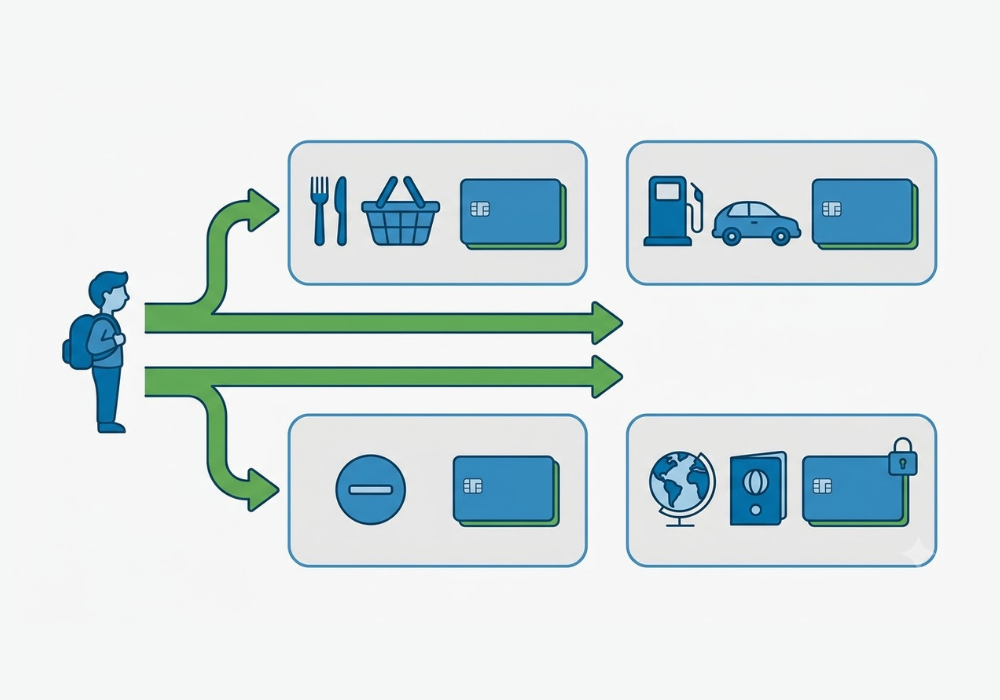
Ask yourself four questions:
- Where does most of your money go? If it’s food and groceries, the Savor Student is hard to beat. If it’s gas and eating out, look at the Discover Chrome. If your spending is all over the place, a flat 1.5% card is easiest.
- Will you actually activate rotating categories? Be honest. If not, skip the Discover it Student Cash Back.
- Do you have a Social Security number? If not, focus on cards like Firstcard that accept other documents.
- Where do you bank? Your existing bank may approve you more easily, and having everything in one app makes autopay simple.
Remember that the rewards matter far less than the credit history you’re building. A card you use responsibly for four years is worth more than any welcome bonus.
Who qualifies for a student credit card?
Most student cards are designed for people with no credit history, so you don’t need a credit score to apply. Issuers typically look at:
- Your age. You generally need to be at least 18.
- Your income. Under the federal CARD Act, if you’re under 21, you have to show independent income or assets you can access, or apply with a cosigner (though few issuers allow cosigners). Income can include part-time job wages, scholarships or grants left over after tuition, and regular money you receive from family in some cases. Student loan money generally doesn’t count.
- Student status. Many student cards ask for proof that you’re enrolled in college or another post-secondary program.
- A Social Security number or ITIN, for most cards.
- A clean record. Having no credit is fine. Having negative credit, like past-due accounts, can lead to a denial.
How to build credit with your first student card
The card is just the tool. These habits are what actually build your score:
- Pay the full statement balance on time every month. Payment history is the biggest factor in your credit score. Set up autopay for at least the minimum payment so you never miss a due date.
- Keep your balance low. Try to use less than 30% of your credit limit, and ideally under 10%. On a $500 limit, that means keeping your statement balance under about $50 to $150.
- Use it for small, planned purchases. Put one or two regular bills on the card, like a streaming subscription or your phone bill, and pay it off.
- Don’t carry a balance. Student card APRs often run well above 20%. Paying in full means you never pay interest.
- Don’t apply for several cards at once. One card is plenty for your first six to twelve months.
- Keep your first card open, even after you graduate to a better one. Its age helps your score.
- Check your credit for free. You can get free weekly reports at AnnualCreditReport.com and track your score in most card apps. Our Experian credit report guide shows how to read your report and fix errors.
Follow these steps and most students see their first FICO score within about six months, with a good score possible within a year or two. For the full playbook, see our guide on how to build credit from scratch.
Alternatives if you can’t get a student card
- Become an authorized user on a parent’s well-managed card. Their positive history can show up on your credit report.
- Get a secured card, where your deposit sets your limit. Our credit builder card guide covers the best options.
- Try a credit-builder loan from a credit union.
- Look at other starter cards. Our list of good credit cards to build credit includes options beyond student cards.
Student credit cards vs. student loans
Don’t confuse the two. A student credit card is a revolving line of credit for everyday purchases, and you should pay it off in full each month. Student loans pay for tuition and are repaid over years. Paying your student loans on time also builds credit, and it matters even more once you graduate. If you’re still choosing how to pay for school, see our guide to the best student loans for college. If you already have federal loans, our MOHELA student loans guide explains the big 2026 repayment changes.
Frequently asked questions
What is the best student credit card in 2026?
For most students, the Capital One Savor Student Cash Rewards card is the top pick, with 3% back on dining, groceries, entertainment, and streaming and a $0 annual fee. Discover it Student Chrome is best for simple rewards, and Quicksilver Student is best for flat 1.5% cash back.
Can I get a student credit card with no credit history?
Yes. Student credit cards are designed for people with no credit history, and many issuers say no credit score is required to apply. You’ll usually need to be at least 18, show some income, and provide a Social Security number or ITIN.
What income can I list on a student credit card application?
If you’re under 21, you need independent income or assets you can access, like part-time job wages, scholarships or grants left over after tuition, or savings. Student loan money generally doesn’t count. If you’re 21 or older, issuers may consider household income you have reasonable access to.
Do student credit cards build credit?
Yes, as long as the card reports to the credit bureaus, which all major student cards do. Paying on time every month and keeping your balance low builds a positive history, and most people get their first credit score within about six months.
Can international students get a credit card in the U.S.?
Yes, but options are limited without a Social Security number. Cards like the Firstcard Secured Credit Builder Card are designed for international students and accept other documentation. Some banks also issue cards with an ITIN.
Should I get a student card or a secured card?
If you qualify, a student card is usually better because it requires no deposit and often earns rewards. A secured card is a good backup if you’re denied a student card, don’t have qualifying income, or don’t have an SSN.
How many credit cards should a college student have?
One is enough to start. Use it for six to twelve months, pay it in full every month, and only consider a second card once you have a credit score and a steady habit of paying on time.
This article is for educational purposes only and is not financial advice. It is not affiliated with or endorsed by any card issuer, and card details are summarized from issuer and industry sources as of October 2026. Rewards, bonuses, APRs, fees, and eligibility rules change frequently. Always review current terms on the issuer’s website before applying, and borrow only what you can repay in full.


This Post Has One Comment