
Quick answer: Online banks are FDIC-insured banks that operate without branches, which lets them pay much higher savings rates, often 4% or more in 2026, compared with the 0.01% many big banks pay. Fintech apps are technology companies that provide banking features through a partner bank rather than being banks themselves. Reputable online banks and fintech apps are safe to use as long as your money sits in an FDIC-insured account, but the fintech distinction matters: your insurance depends on the partner bank, so it pays to verify it. The trade-off for higher rates is no branches and limited cash handling.
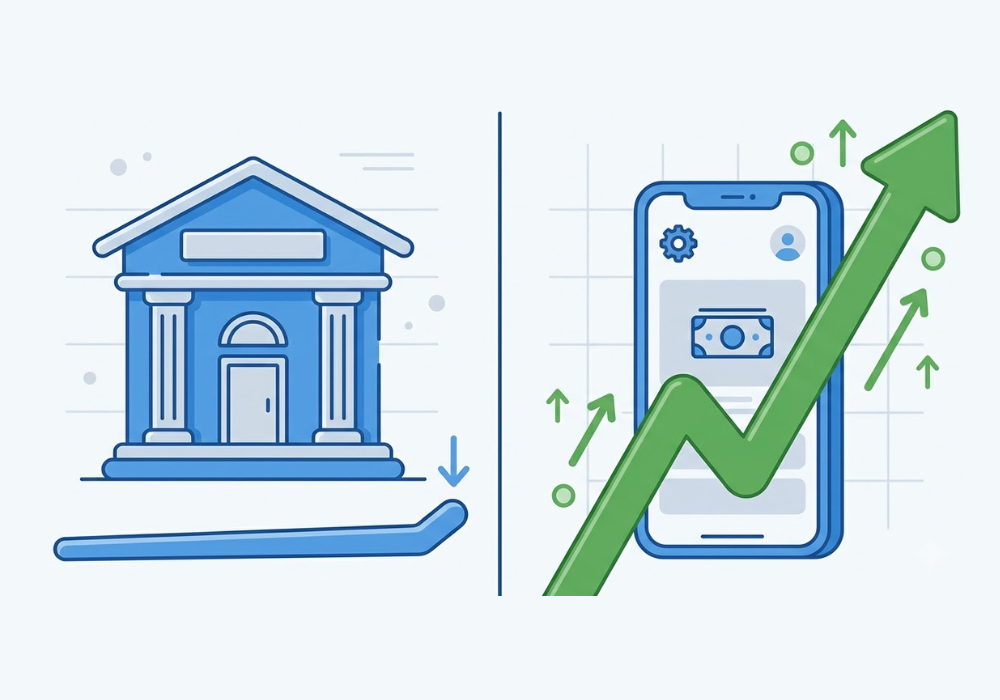
Big banks are paying next to nothing while online banks pay real interest, and the gap has never been wider. On a $25,000 emergency fund, that difference is worth roughly $1,000 a year. Yet many people hesitate to move their money, because banking through an app raises a fair question: is it actually safe? This guide explains how online banks and fintech apps work, answers the safety question honestly, and shows you how to choose and switch.
What are online banks and fintech apps?
The terms get used loosely, but the differences matter, especially for safety. There are really three things people mean.
Online banks. These are chartered, FDIC-insured banks that simply have no physical branches. Ally, Marcus by Goldman Sachs, and Capital One 360 are examples. Your money is held by the bank itself and insured like it would be at any bank.
Fintech apps (neobanks). These are technology companies that offer bank-like features, such as Chime or many cash management apps. They are not banks. They partner with a chartered bank behind the scenes to hold your money and provide FDIC insurance. The app builds the experience; the partner bank holds the deposits.
Cash management accounts. Offered by brokerages and robo-advisors like Wealthfront, these sweep your cash into one or more partner banks for FDIC coverage.
The key takeaway: an online bank is a bank, while a fintech app is a company sitting in front of a bank. Both can be perfectly safe, but you protect yourself by knowing which one you are using and where your money actually rests.
Why online banks pay so much more
The reason online banks offer better rates comes down to overhead. Without thousands of branches and the staff to run them, they have far lower costs, and they pass much of that savings back to you as interest.
The numbers are striking. According to the FDIC, the average savings account paid about 0.38% in mid-2026, and many national banks pay as little as 0.01%. Meanwhile, top online banks and fintech apps paid 4% or more, roughly eight to ten times the national average, usually with no monthly fees and no minimum balance. Those rates move with the Federal Reserve’s benchmark, which sat in the 4.25% to 4.50% range in 2026, so high-yield accounts could advertise APYs near that level.
Put simply, keeping a large balance at a 0.01% big-bank account means leaving real money on the table every year.
Are online banks and fintech apps safe?
This is the question that stops most people, and the honest answer is: yes, reputable ones are safe, with one important nuance for fintech apps.
Start with insurance. The core protection is FDIC insurance for banks, or NCUA insurance for credit unions, which covers up to $250,000 per depositor, per institution, if the bank fails. Every legitimate online bank carries it. As long as your account is FDIC-insured and you stay within the limits, your deposits are protected even if the bank goes under.
The fintech nuance. Because a fintech app is not itself a bank, its FDIC coverage is passed through its partner bank. In most cases that works fine, but there is a catch worth understanding. FDIC insurance protects against a bank failing. It does not protect against a non-bank fintech or a middleware company in between failing, or against sloppy recordkeeping about who owns what. A 2024 collapse of a banking-technology middleman left customers of several popular apps temporarily locked out of their own money, even though the underlying banks were fine, precisely because the records of who was owed what broke down. The lesson is not that fintech apps are unsafe, but that the app-plus-partner structure adds a layer of risk a direct bank account does not have.
How to protect yourself. A few simple checks go a long way:
- Verify FDIC or NCUA insurance. Look up the institution on the FDIC’s BankFind tool, and for a fintech app, confirm which partner bank holds your deposits.
- Prefer apps that are transparent about their partner bank and coverage, and be cautious with any that are vague.
- Use strong security, including two-factor authentication and a unique password. Reputable providers use bank-level encryption and fraud monitoring.
- Watch teaser rates. Some accounts advertise a high introductory APY that drops after a few months. Read the fine print.
For everyday balances at a well-known FDIC-insured online bank, the safety difference versus a traditional bank is minimal. The extra caution mainly applies to newer fintech apps and to balances above the insurance limit.
Online banks vs. traditional banks
Each model has real strengths. Here is how they compare on what matters most.
| Feature | Online banks and fintech apps | Traditional banks |
|---|---|---|
| Savings APY | Often 4% or more | Frequently 0.01% to 0.40% |
| Monthly fees | Usually none | Often charged, sometimes waivable |
| Branches | None, app and web only | Physical branches |
| ATM access | Large fee-free networks and reimbursements | Own ATMs plus branches |
| Cash deposits | Limited and awkward | Easy at a branch |
| Customer service | Phone, chat, and in-app | In person and by phone |
| Digital tools | Strong, with goals, buckets, and automation | Varies, often less advanced |
| Best for | Maximizing interest, low fees, mobile-first users | In-person service, cash needs, complex banking |
Pros and cons of online banking
The upside:
- Much higher interest on savings, which compounds over time.
- Lower or no fees and minimal balance requirements.
- Strong apps with budgeting, savings goals, and automation built in.
- Convenience, with 24/7 access from your phone.
The trade-offs:
- No branches, so in-person help is not an option.
- Cash deposits are difficult, which matters if you handle cash often.
- Customer service is remote, which some people find slower for complex issues.
- The fintech structure can add a layer of risk if you are not using a direct bank account.
Who should use an online bank, and who might not
An online bank or fintech app is a strong fit if you want to maximize interest, keep fees low, rarely need to deposit cash, and are comfortable managing money on your phone. For most savers, moving an emergency fund or savings balance to a high-yield online account is one of the easiest wins in personal finance.
A traditional bank may still suit you if you regularly deposit cash, prefer face-to-face service, or have complex needs like certain business banking or in-person notary and safe-deposit services. Many people use both: a traditional bank or credit union for everyday checking and cash, and an online bank for high-yield savings. You are not locked into one choice.
How to choose an online bank or fintech app
Rate matters, but it is not the only thing. Run through this checklist:
- FDIC or NCUA insured. Non-negotiable. Verify it, and for fintech apps confirm the partner bank.
- Competitive APY without gimmicks. A strong ongoing rate beats a teaser that expires, and check whether the rate requires direct deposit or a minimum balance.
- Low or no fees and minimums. Avoid accounts that claw back your interest with maintenance fees.
- ATM access. Look for a large fee-free ATM network or ATM fee reimbursements.
- App quality and transfer speed. A smooth app and fast transfers save you real time and stress.
- Customer service and reputation. Check reviews and support options before committing.
Remember that a small APY difference is minor on typical balances. A frustrating app or slow transfers can cost you more in aggravation than a tenth of a percent earns you.
How to open or switch to an online bank
- Choose your account using the checklist above, confirming FDIC or NCUA insurance first.
- Open the account online, which usually takes minutes and requires your ID, Social Security number, and funding details.
- Fund it with a transfer from your existing bank.
- Move recurring items gradually. Redirect direct deposits and automatic payments, and keep your old account open until everything has switched cleanly.
- Keep balances within insurance limits, spreading funds across institutions if you exceed $250,000.
Frequently asked questions
Are online banks safe? Yes, reputable online banks are safe as long as they are FDIC-insured, which protects up to $250,000 per depositor if the bank fails. They use bank-level security, and your deposits are protected the same as at a traditional bank.
Are fintech banking apps FDIC insured? Fintech apps are usually not banks themselves, so their FDIC coverage is passed through a partner bank. In most cases your money is insured, but you should confirm which partner bank holds your deposits, since the insurance depends on that bank, not the app.
Why do online banks offer higher interest rates? Online banks have no branches and far lower overhead than traditional banks, so they pass those savings on as higher interest. That is why they often pay 4% or more when many big banks pay just 0.01%.
What is the difference between an online bank and a fintech app? An online bank is a chartered, FDIC-insured bank without branches, and it holds your money directly. A fintech app is a technology company that offers banking features through a partner bank, so the bank behind it actually holds and insures your deposits.
Can I deposit cash at an online bank? Usually not easily. Most online banks have no branches, so cash deposits are limited or awkward. If you handle cash regularly, keeping a traditional bank or credit union account alongside an online bank often works best.
What happens to my money if an online bank fails? If the bank is FDIC-insured and you are within the $250,000 limit, your deposits are protected and reimbursed. The main added risk with fintech apps is that a non-bank failure or recordkeeping breakdown could still delay access, even when the underlying bank is fine.
Should I switch from a traditional bank to an online bank? For high-yield savings, it is often worth it, since the interest difference can be hundreds or thousands of dollars a year. Many people keep a traditional account for cash and in-person needs while using an online bank for savings.
This article is for educational purposes only and is not financial advice. Interest rates, fees, features, and partner-bank arrangements change frequently, and any banks or apps mentioned are examples, not recommendations. Always verify FDIC or NCUA insurance and current terms directly with the provider before opening an account.


This Post Has One Comment