
Quick answer: In the VTI vs VTSAX decision, you’re not choosing between two portfolios. Both are versions of the same Vanguard fund, holding the same U.S. stocks. VTI is the ETF: slightly cheaper at 0.03% a year, no minimum beyond one share, and easy to hold at any broker. VTSAX is the mutual fund: 0.04% a year, a $3,000 minimum, and better for automatic dollar-amount investing at Vanguard.
Key takeaways
- VTI and VTSAX are both part of the Vanguard Morningstar Total Stock Market Index Fund, which had about $1.8 trillion in net assets as of October 31, 2026.
- Expense ratios: 0.03% for VTI and 0.04% for VTSAX, as of April 2026. On $10,000, that’s $3 versus $4 a year.
- VTSAX requires $3,000 to start. VTI only requires enough for one share, or less with fractional shares.
- You can convert VTSAX to VTI tax-free at Vanguard, but you can’t convert VTI back.
VTI and VTSAX are the same fund in two wrappers
Vanguard runs one big portfolio, the Vanguard Morningstar Total Stock Market Index Fund, and sells access to it in different forms. VTSAX is the Admiral Shares mutual fund class. VTI is the exchange-traded version. Same stocks, same manager, same index.
You may have seen the old name. In July 2026, Vanguard renamed the fund after Morningstar rebranded the CRSP indexes it bought. The CRSP US Total Market Index is now the Morningstar US Total Market Index, and Morningstar says the change affects naming only, with index methodology unchanged. Nothing about what you own changed.
That index covers nearly the entire U.S. stock market: large, mid, small and micro-cap companies. Vanguard listed more than 3,500 stocks in the fund in November 2026. If you’re comparing it with an S&P 500 fund instead, our VOO vs VTI breakdown covers that decision.
VTI vs VTSAX side by side
| VTI (ETF) | VTSAX (mutual fund) | |
|---|---|---|
| Expense ratio | 0.03% | 0.04% |
| Minimum to start | Price of one share (or less with fractional shares) | $3,000 |
| How it trades | All day on an exchange, at market prices | Once a day at the closing price (NAV) |
| Where you can buy | Almost any brokerage, usually commission-free | Best at Vanguard; other brokers may charge a fee |
| Automatic investing | Depends on your broker | Easy, in exact dollar amounts, at Vanguard |
| Holdings | Identical: the whole U.S. stock market | |
Expense ratios as of April 28, 2026, from Vanguard’s fund pages.
Cost: VTI is cheaper, but barely
A 0.01 percentage point gap sounds like nothing, and for most people it is close to nothing. On a $10,000 balance, VTI costs about $3 a year and VTSAX about $4. Even at $500,000, the difference is around $50 a year.
| Balance | VTI yearly cost (0.03%) | VTSAX yearly cost (0.04%) | Difference |
|---|---|---|---|
| $10,000 | $3 | $4 | $1 |
| $50,000 | $15 | $20 | $5 |
| $100,000 | $30 | $40 | $10 |
| $500,000 | $150 | $200 | $50 |
The bigger cost risk is where you buy. VTI trades commission-free at most large brokerages. VTSAX is cheapest to buy at Vanguard. Some other brokerages charge a transaction fee to buy outside mutual funds, which can easily wipe out years of the expense-ratio difference if you invest small amounts often. Check your broker’s fee schedule before you choose.
Buying and trading: how each one works day to day
VTI behaves like a stock. You can buy or sell any time the market is open, and the price moves through the day. You need enough for one share, unless your broker offers fractional shares, which many now do.
VTSAX works like a traditional mutual fund. You put in a dollar amount, and your order fills once a day at that day’s closing price. You need $3,000 for the first purchase, but after that you can add any amount.
For long-term investors, intraday trading isn’t a real advantage. If anything, a once-a-day price removes the temptation to time the market. What matters more is which one fits the way you actually invest.
Automatic investing: where VTSAX shines
If you want to invest a set amount every payday, say $250 every two weeks, VTSAX makes it simple at Vanguard. You pick the amount and schedule, and every dollar goes in, no matter the share price.
VTI can do the same thing if your broker supports automatic investing in ETFs with fractional shares. If it doesn’t, you’ll be buying whole shares, leaving leftover cash uninvested, or doing it by hand. Before you settle on VTI for a hands-off plan, confirm your broker supports recurring fractional purchases.
Performance: why the returns look almost identical
Because VTI and VTSAX own the same stocks in the same proportions, their returns move together almost exactly. Over any long stretch, the gap between them roughly equals the 0.01% difference in expense ratio, plus tiny effects from how ETF prices trade versus the mutual fund’s end-of-day price.
If you see a bigger difference on a chart, check the dates. ETF returns are often shown on market price, while mutual fund returns use net asset value, and those can differ slightly on any single day. Over years, they converge.
So don’t pick between them based on past performance. Pick based on cost where you buy, minimums and how you want to invest, which is where the VTI vs VTSAX choice actually matters.
Taxes and moving your money
Inside an IRA or 401(k), taxes don’t matter day to day, so pick whichever is cheaper and easier where you hold it. In a regular taxable account, two rules are worth knowing.
First, conversions only go one way. Vanguard lets you convert mutual fund shares to ETF shares of the same fund, and says the conversion is tax-free when you hold both through Vanguard. You can’t convert ETF shares back. Selling VTI to buy VTSAX would be a sale, and possibly a taxable one.
Second, portability. An ETF like VTI can be held at nearly any brokerage, so if you switch brokers later you can usually move it as-is. A Vanguard mutual fund is easiest to hold at Vanguard. That’s one reason many people who might switch brokers someday lean toward the ETF in taxable accounts.
If you’re investing in a taxable account, our guide to the 0% capital gains bracket explains when you can sell funds like these without owing federal tax on the gains.
Three common situations
A new investor at Fidelity with $500. VTI is the easy pick. VTSAX’s $3,000 minimum rules it out, and buying a Vanguard mutual fund at another broker can add fees. With fractional shares, the whole $500 can go in on day one.
A Vanguard customer saving $400 every month. VTSAX fits once the first $3,000 is in. Automatic investments go in as exact dollar amounts, and there’s nothing to think about each month. The extra 0.01% in cost is a fair trade for that convenience.
A long-time VTSAX owner thinking about switching brokers. Converting to VTI at Vanguard first, which Vanguard says is tax-free, makes the holding easier to move later. Just remember the conversion is one-way.
In each case, the VTI vs VTSAX answer comes down to the account, not the fund.
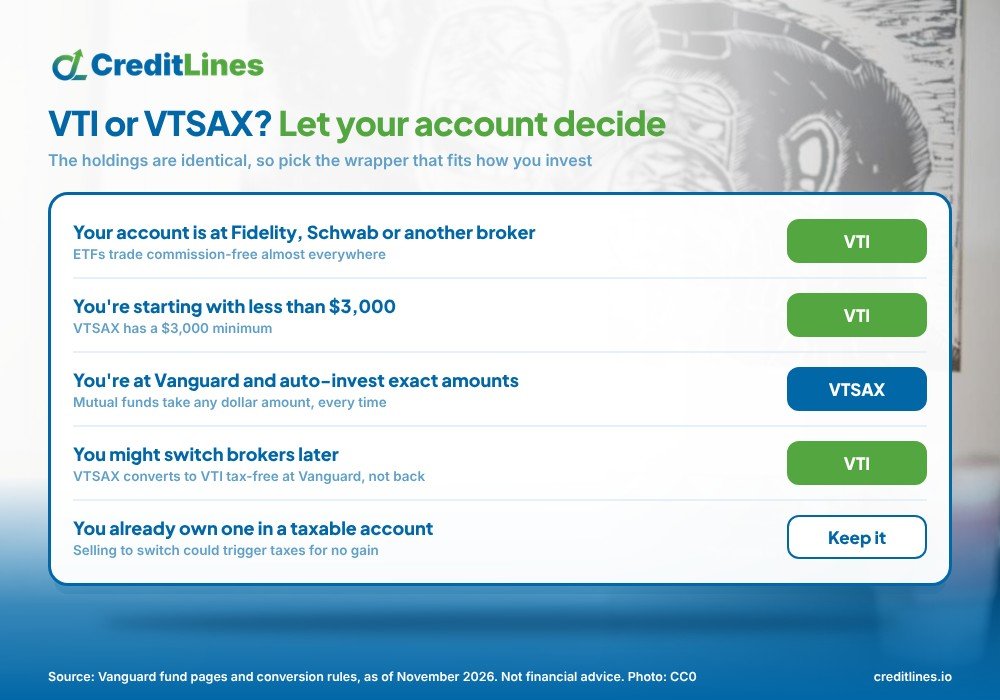
VTI vs VTSAX: which should you buy?
Choose VTI if:
- Your account is at Fidelity, Schwab or another non-Vanguard broker.
- You’re starting with less than $3,000.
- You want the lowest possible expense ratio and maximum flexibility to move brokers.
Choose VTSAX if:
- Your account is at Vanguard and you want to automate exact dollar amounts.
- You already have $3,000 or more to start.
- You’d rather not see prices move through the day.
If you already own one, there’s rarely a good reason to switch. The holdings are the same, and selling in a taxable account could trigger a tax bill for no real benefit.
Who might want neither
A total market fund is a strong core holding, but it isn’t a complete plan for everyone. It owns no bonds and no international stocks, so it can drop sharply in a bad year for U.S. stocks. If you’re close to needing the money, or you want a single fund that handles the mix for you, a target-date or balanced fund may fit better. And if you’re just starting with a small amount, our guide on how to start investing with $100 walks through the first steps.
Frequently asked questions
Is VTSAX the same as VTI?
They hold the same portfolio. Both belong to the Vanguard Morningstar Total Stock Market Index Fund and track the Morningstar US Total Market Index. VTSAX is the mutual fund share class and VTI is the ETF. They differ in expense ratio, minimum investment and how you trade them, but their returns before costs are essentially the same.
Can I switch from VTSAX to VTI without paying taxes?
Yes, at Vanguard. Vanguard lets you convert mutual fund shares into ETF shares of the same fund, and says the conversion is tax-free when you hold both through Vanguard. The reverse isn’t allowed: you can’t convert VTI back into VTSAX, so switching that way would mean selling, which can be taxable in a regular account.
Did VTI change its index in 2026?
Only the name. Morningstar bought CRSP and renamed its indexes, so the CRSP US Total Market Index became the Morningstar US Total Market Index in July 2026, and Vanguard renamed its fund to match. Morningstar says the methodology is unchanged, so the fund still owns the same broad U.S. market.
What is the minimum investment for VTSAX?
Vanguard lists a $3,000 minimum initial investment for VTSAX. After that first purchase, you can add any amount, including small automatic contributions. VTI has no set minimum beyond the price of a share, and many brokers sell fractional shares, so you can start with a few dollars.
Is VTI or VTSAX better for a Roth IRA?
Either works well, since taxes on trades don’t matter inside a Roth IRA. Pick based on where your IRA is held and how you like to invest. At Vanguard with automatic contributions, VTSAX is convenient once you have $3,000. At another broker, or starting smaller, VTI is usually simpler.
Sources
- Vanguard, VTI fund profile (expense ratio, index)
- Vanguard, VTSAX fund profile (expense ratio, minimum, fund assets)
- Vanguard, What are exchange-traded funds (conversions)
- Morningstar, Rebrand of CRSP Market Indexes completed (July 28, 2026)
- Vanguard, Share classes of Vanguard mutual funds
This article is for educational purposes only and is not financial advice. Fund details change, so confirm current figures on Vanguard’s website before you invest.