
Quick answer: In the HELOC vs home equity loan decision, the deciding question is how you’ll spend the money. A home equity loan pays you one lump sum at a fixed rate, so it suits a single cost you can price today. A HELOC is a credit line with a variable rate that you draw from as needed, so it suits projects or expenses that arrive in stages.
Key takeaways
- Both loans use your home as collateral. Miss enough payments and you can lose the house.
- Average rates are close right now: 8.12% for a HELOC and 8.27% for a 10-year home equity loan, as of November 10, 2026.
- A HELOC charges interest only on what you’ve drawn. A home equity loan charges interest on the full amount from day one.
- The HELOC’s risk is a rising rate and a payment jump when the draw period ends. The home equity loan’s risk is borrowing more than you end up needing.
HELOC vs home equity loan at a glance
Here’s how the two compare on the points that usually decide it.
| Home equity loan | HELOC | |
|---|---|---|
| How you get the money | One lump sum at closing | Draw what you need, when you need it, up to your limit |
| Interest rate | Fixed APR | Variable APR tied to the prime rate (some lenders let you lock part of it) |
| Payments | Same principal and interest payment every month | Often interest-only during the draw period, then principal and interest |
| You pay interest on | The whole loan | Only the balance you’ve drawn |
| Upfront costs | Closing costs such as appraisal and origination fees are common | Many banks cover closing costs, but may claw them back if you close early |
| Best for | One known expense: a new roof, a debt payoff | Costs spread over time: a remodel in phases, tuition, a cash cushion |
| Biggest risk | Paying interest on money you didn’t need | Rate increases and a payment jump after the draw period |
How a home equity loan works
A home equity loan is a second mortgage with a fixed rate. You borrow a set amount, get it all at closing, and repay it in equal monthly payments over a fixed term, commonly 10 or 15 years. Your rate never changes, so the payment you sign up for is the payment you make until it’s paid off.
That predictability is the whole point. If you know a contractor’s bid is $48,000 and it won’t change, a home equity loan lets you lock the cost of borrowing on day one. The trade-off is that interest starts on the full balance immediately, even if the money sits in your checking account for a few months.
How a HELOC works
A HELOC works more like a credit card secured by your house. The lender approves a limit, and during the draw period (often 10 years, sometimes 20) you borrow, repay and borrow again. Many HELOCs only require interest payments during that stretch.
Then the repayment period starts. You can’t draw anymore, and your payment now has to cover principal too. On a large balance, that change can raise the monthly bill sharply, so it’s worth planning for long before it arrives.
Two more things set HELOCs apart. First, the rate floats with the prime rate, which is 7.00% as of November 2026 after rising in September. Second, the Federal Trade Commission notes that a lender may freeze or reduce your line if your home’s value drops significantly below its appraised amount, or if it reasonably believes your finances have changed enough that you can’t pay. If you’re counting on the line for a future expense, that’s a real risk.
If you want a HELOC’s flexibility but not its rate swings, several banks let you lock part of your balance at a fixed rate. We explain how that works, and what it costs, in our guide to the fixed rate HELOC.
What each one costs right now
The national averages are closer than many people expect. As of November 10, 2026, Mortgage Research Center data reported by Fortune put the average HELOC at 8.117%, the 10-year home equity loan at 8.268% and the 15-year home equity loan at 8.280%. Those averages assume an owner-occupied single-family home, an 80% loan-to-value ratio and a FICO score of 620 or higher, so your quote may be higher or lower.
The rate is only part of the cost. Watch for:
- Closing costs. Home equity loans commonly come with appraisal, origination and title fees. Many HELOCs advertise no closing costs: Bank of America, for example, charges no application or closing fees on lines up to $1,000,000.
- Early closure fees. “No closing costs” often has a catch. Bank of America charges $450 if you close the line within 36 months, and U.S. Bank charges 1% of the line amount, up to $500, if you close within 30 months.
- Annual fees. Some HELOCs charge one. U.S. Bank’s is $75 a year after the first year unless you qualify for a waiver.
For current lender-by-lender HELOC rates and fees, see our roundup of the best HELOC lenders.
A $50,000 example over 10 years
Say you borrow $50,000 and repay it over 10 years. The table uses the November 2026 national averages above. It’s an illustration, not a quote, and it leaves out fees.
| Scenario | Rate | Monthly payment | Total interest |
|---|---|---|---|
| Home equity loan, 10-year fixed | 8.268% | $613.74 | $23,649 |
| HELOC, rate never moves | 8.117% | $609.73 | $23,168 |
| HELOC, rate rises 1 point after year 2 | 9.117% from year 3 | $609.73, then $631.84 | $25,290 |
| HELOC, rate falls 1 point after year 2 | 7.117% from year 3 | $609.73, then $588.08 | $21,089 |
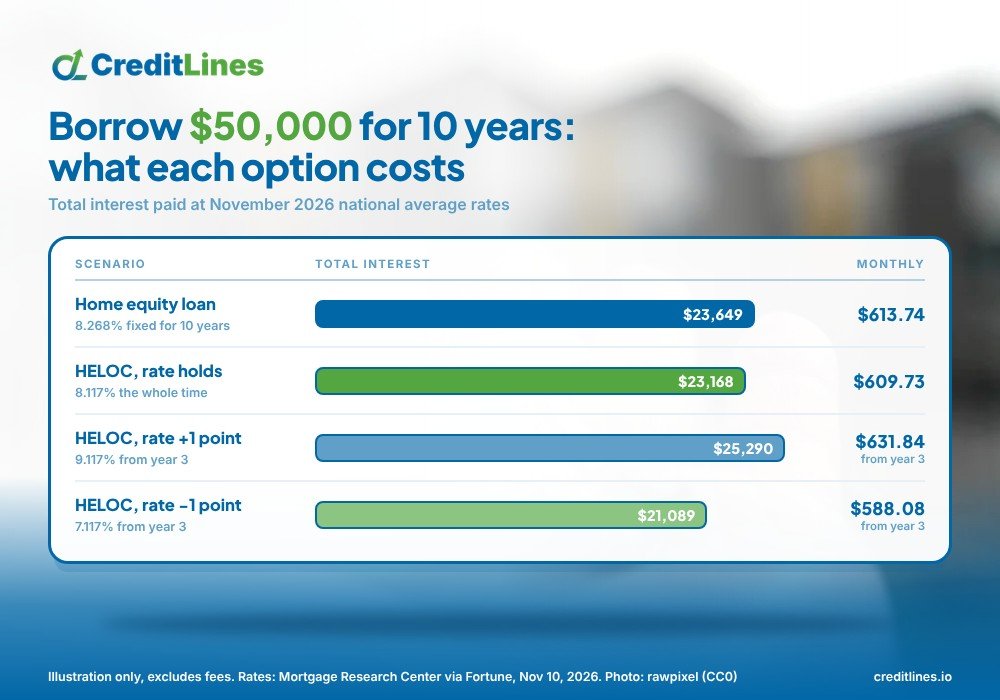
On these numbers, the two cost almost the same if rates hold still. The HELOC wins if rates drop and loses if they climb. The home equity loan costs you a little certainty premium, about $4 a month here, in exchange for knowing your total cost up front.
Where a HELOC really pulls ahead is when you don’t need all the money at once. If you draw $25,000 now and the other $25,000 a year later, you pay interest on half the balance for that first year. At 8.117%, that’s roughly $2,029 in interest instead of about $4,059 on the full amount. Run your own numbers with our free HELOC calculator.
Which one fits your situation?
Most HELOC vs home equity loan decisions come down to a few situations. Work through these in order and stop at the first one that matches:
- You know the exact cost and need it all now (a quoted roof replacement, paying off a high-rate debt in one go): a home equity loan usually fits best.
- The cost will come in stages or you’re not sure of the final number (a remodel, college bills each semester): a HELOC fits better, because you only pay interest on what you use.
- You want a backup fund you hope never to touch: a HELOC, though keep in mind the lender can freeze it in a downturn, exactly when you might need it.
- A rising payment would strain your budget: a home equity loan, or a HELOC where you lock the balance at a fixed rate.
- You’ll repay within a year or two: a HELOC, ideally one with no closing costs. Just check the early closure fee first.
If none of these fit, or you’d rather not put your house on the line, an unsecured personal loan costs more but doesn’t use your home as collateral.
Where a cash-out refinance fits in
A third option sometimes comes up in the HELOC vs home equity loan comparison: a cash-out refinance. It replaces your current mortgage with a bigger one and pays you the difference in cash. You end up with one loan and one payment instead of two.
The catch is your existing rate. A cash-out refinance resets the rate on your entire mortgage balance, not just the new cash. If your first mortgage carries a low rate from a few years ago, refinancing all of it to tap some equity can cost far more over time than a second loan would. It mostly makes sense when today’s mortgage rates are close to, or below, the rate you already have. Our refinance calculator shows the break-even point.
Questions to ask before you sign
Whichever loan you lean toward, get these answers in writing. They’re where the real differences between lenders hide.
- What’s the APR, and for a HELOC, what’s the margin over prime and the rate cap?
- Which closing costs do I pay, and is there a fee if I close or pay off early?
- Is there an annual fee or a minimum draw?
- For a HELOC, how long is the draw period, and what will my payment be when repayment starts on the full limit?
- Can I lock part of a HELOC balance at a fixed rate, and what does that cost?
- Is there a balloon payment at the end?
Comparing two or three written offers side by side usually settles the HELOC vs home equity loan question faster than any rule of thumb. If one lender’s numbers look far better than the rest, read the fee section twice.
Pros and cons side by side
| Pros | Cons | |
|---|---|---|
| Home equity loan | Fixed rate and payment; easy to budget; no draw-period payment jump | Interest on the full amount from day one; closing costs are common; you need a new loan to borrow more |
| HELOC | Borrow only what you need; often no closing costs; reuse the line as you repay | Variable rate; payment can jump when repayment starts; lender can freeze or cut the line |
Who should skip both: anyone whose income is shaky or who’d use the money for everyday spending. Turning credit card debt into home equity debt only helps if the card balances don’t come back, because the new debt is secured by your house.
Frequently asked questions
Can I cancel a HELOC or home equity loan after signing?
Yes, in many cases. Under the federal three-day rule, you can cancel a home equity loan or HELOC within three business days for any reason and without penalty, as long as your main home is the collateral. It doesn’t apply to vacation or second homes. You must cancel in writing, not by phone or in person.
Is interest on a HELOC or home equity loan tax deductible?
Only if you use the money to buy, build or substantially improve the home that secures the loan, according to IRS Publication 936. The 2025 tax law made that rule permanent. The interest also counts toward the $750,000 limit on mortgage debt. Interest on money used for a car, tuition or credit cards isn’t deductible.
Does a home equity loan have a balloon payment?
A standard home equity loan doesn’t, because each payment covers principal and interest. The FTC warns that interest-only home equity loans usually do end with a large lump-sum balloon payment. Before you sign, check that your payments fully pay off the loan by its maturity date.
What happens to a HELOC or home equity loan when I sell my house?
Both are liens on your home, so they’re normally paid off from the sale proceeds at closing, along with your first mortgage. Your lender sends a payoff amount to the closing agent. If the sale price won’t cover everything you owe, you’ll need to bring cash to closing or work out a plan with the lenders.
Can I have a HELOC and a home equity loan at the same time?
It’s possible, but lenders limit how much of your home’s value all your loans can use together. Bank of America, for example, generally caps that combined loan-to-value at 85%. A home equity loan may leave little room for a HELOC, so some borrowers use a HELOC with a fixed-rate lock option to get both features in one account.
Sources
- Fortune, home equity loan and HELOC rates for November 11, 2026 (Mortgage Research Center data as of November 10)
- Federal Trade Commission, Home Equity Loans and Home Equity Lines of Credit
- IRS Publication 936, Home Mortgage Interest Deduction
- Iowa State University Center for Agricultural Law and Taxation, One Big Beautiful Bill Act tax provisions
- Bank of America, Home Equity Line of Credit
- U.S. Bank, Home Equity Line of Credit
- Prime rate and October 28, 2026 FOMC decision
This article is for educational purposes only and is not financial advice. Rates and terms change often, so confirm details with your lender.


This Post Has One Comment