
Quick answer: As of August 2026, the best-paying CDs generally offer around 4.15% to 4.50% APY for short- and mid-term certificates, with the highest yields coming from online banks and credit unions, and a few credit unions occasionally running promotions near 5%. CD rates have been falling since the Federal Reserve began cutting rates in late 2024, and they may drop further, which is why locking in a competitive rate now can be a smart move. The best-paying CD for you, though, is not just the highest APY, it is the top rate on a term that matches when you will need your money.
A certificate of deposit is one of the few places you can still earn a guaranteed return above 4% with zero risk to your principal. But that window may be closing. With rates trending down, the savers who act now can lock in today’s yields for months or years, even as everyone else’s rates fall. This guide shows you the current best-paying CD rates, where to find them, how to choose the right one, and how to squeeze the most out of your savings.
What is a CD and how does it pay?
A certificate of deposit, or CD, is a savings account that pays a fixed interest rate for a set period of time, called the term. In exchange for locking your money away, you typically earn a higher rate than a regular savings account, and the rate is guaranteed for the entire term no matter what happens in the market.
A few essentials to know:
- APY is what matters. The annual percentage yield reflects your true yearly earnings including compound interest, so compare CDs by APY, not the plain interest rate.
- Your money is insured. CDs at FDIC-insured banks and NCUA-insured credit unions are protected up to $250,000 per depositor, per institution.
- There is a catch: early withdrawal penalties. Pull your money out before the term ends and you usually forfeit some interest, often 90 to 180 days’ worth or more.
Current best CD rates in 2026
Rates change daily, but here is the lay of the land as of August 2026. Top-paying CDs cluster in the low-to-mid 4% range across most terms, with online banks and credit unions leading. Always verify the current rate directly with the institution before opening.
| CD term | Typical top APY (August 2026) |
|---|---|
| 3 months | About 4.00% to 4.20% |
| 6 months | About 4.10% to 4.30% |
| 1 year | About 4.15% to 4.50% |
| 18 months | About 4.05% to 4.25% |
| 2 years | About 4.05% to 4.25% |
| 3 years | About 4.00% to 4.35% |
| 5 years | About 4.00% to 4.35% |
A few credit unions have offered promotional rates near 5% APY on select terms, though these often come with membership requirements or higher minimum deposits. The broad market for CDs runs roughly 2.75% to 4.50%, so shopping around genuinely pays.
Why CD rates are falling, and why that matters now
CD rates do not move on their own. They follow the Federal Reserve’s benchmark interest rate. After the Fed began cutting rates in late 2024 and continued through 2025, banks lowered their CD and savings yields in response, and further cuts could push rates lower still.
Here is why that creates urgency, and it is the single most important idea for CD shoppers right now. When you open a CD, you lock in that rate for the entire term. If you secure a 4.30% one-year CD today and rates fall to 3.5% next month, you still earn 4.30% for the full year. A high-yield savings account, by contrast, would see its rate drop right along with the market. In a falling-rate environment, that lock is exactly what makes a CD valuable, and it is why many savers view now as one of the last good chances to secure an elevated rate.
Where to find the best-paying CDs
The best rates are rarely at big national banks, which often pay little on deposits. Look instead to:
- Online banks. With low overhead and no branches, they consistently offer some of the highest CD rates.
- Credit unions. Member-owned and not-for-profit, they frequently top the rate tables, though you may need to meet membership criteria, which is often easy.
- CD marketplaces. Platforms that let you open CDs from many banks in one place, often with very low minimums, make it easy to compare and spread your money across institutions.
Comparing several of these is the surest way to find the best-paying CD for your term.
Types of CDs
Not all CDs are the same, and the type affects both your rate and your flexibility.
| CD type | How it works | Trade-off |
|---|---|---|
| Traditional CD | Fixed rate for a fixed term, penalty for early withdrawal | Best rates, least flexibility |
| No-penalty CD | Lets you withdraw early without a penalty | Usually a slightly lower rate |
| Jumbo CD | Higher rate for large deposits, often $75,000 or more | Requires a big balance |
| Bump-up CD | Lets you raise your rate once if rates rise | Often a lower starting rate |
| Brokered CD | Bought through a brokerage, can be sold before maturity | More complex, with price risk if sold early |
For most savers chasing the best rate, a traditional CD wins on yield. If you want flexibility in case you need the money or rates climb, a no-penalty or bump-up CD trades a little yield for options.
How to choose the best-paying CD for you
The highest APY on the page is not automatically your best choice. Match the CD to your situation:
- Match the term to your timeline. Only lock away money you will not need until the CD matures. If you might need it in six months, do not choose a two-year CD, however good the rate.
- Weigh the early withdrawal penalty. Check how many days’ interest you would forfeit if you had to break the CD early.
- Consider a no-penalty CD for emergency-adjacent money, so you keep access.
- Do not chase a tiny rate difference into the wrong term. An extra 0.05% is not worth locking up money you may need.
The CD ladder: a smarter way to lock in rates
If you cannot decide on one term, a CD ladder solves the dilemma by spreading your money across several CDs with staggered maturity dates.
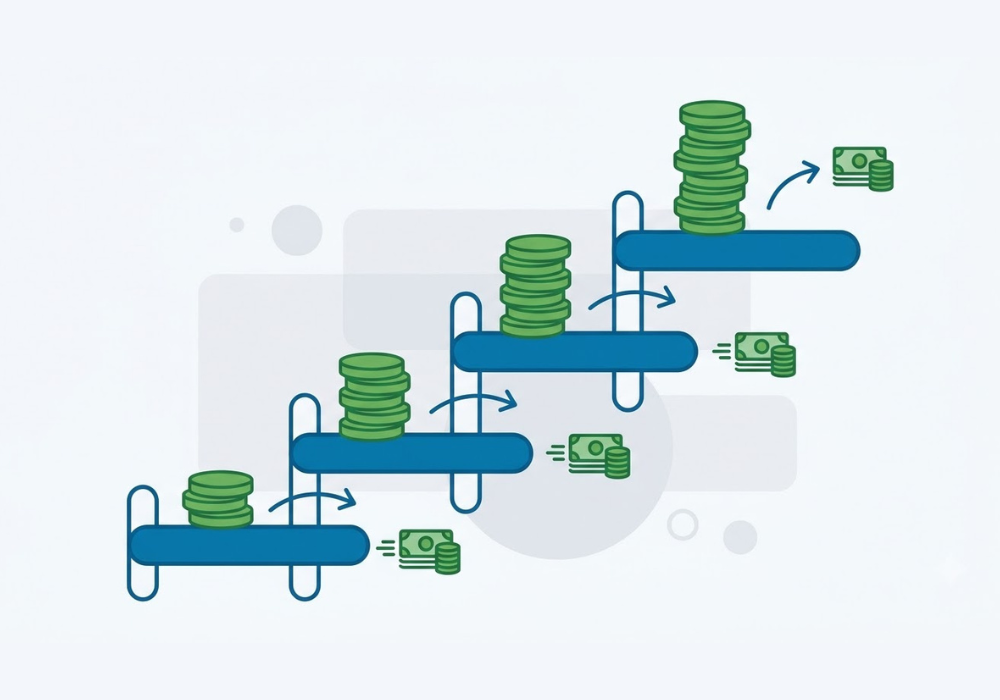
Here is how it works. Instead of putting $10,000 into a single CD, you split it into five CDs of $2,000 each, with terms of one, two, three, four, and five years. Every year, one CD matures, giving you access to cash. You can then spend it or reinvest it into a new five-year CD. Over time, you hold a mix of CDs, earning higher long-term rates while still having money coming available each year. A ladder gives you the best of both worlds: strong rates and regular liquidity, plus protection against locking everything in right before rates change.
Watch out for early withdrawal penalties
The biggest risk with a CD is not losing money, since your principal is insured, it is needing your money early. Traditional CDs charge a penalty for early withdrawal, commonly ranging from about 90 days’ interest on shorter terms to 180 days or more on longer ones. A stiff penalty can wipe out much of your earned interest. That is why matching the term to your timeline matters so much, and why a no-penalty CD can be worth a slightly lower rate for money you might need.
CD vs. high-yield savings account
Both are safe, insured places to earn interest, but they serve different needs.
- A CD locks in a fixed rate for a set term. It is best for money you will not touch, and it shines when rates are falling because your rate is protected.
- A high-yield savings account pays a variable rate and lets you withdraw anytime. It is best for emergency funds and money you may need, but its rate drops when the market falls.
Many savers use both: a high-yield savings account for accessible cash, and CDs to lock in today’s rates on money they can commit for longer.
How to open a CD
- Compare rates and terms across online banks, credit unions, and CD marketplaces, focusing on APY, term, minimum deposit, and the early withdrawal penalty.
- Choose a term that matches your timeline, so you will not need the money before maturity.
- Open the account online, which usually takes minutes.
- Fund the CD with the required minimum deposit.
- Note your maturity date and auto-renewal terms, since many CDs automatically renew, sometimes at a lower rate, if you do nothing.
Tips to maximize your CD earnings
- Lock in sooner rather than later if rates are falling, to secure today’s yield.
- Build a ladder to balance higher rates with regular access to cash.
- Avoid breaking a CD early to sidestep penalties.
- Track your maturity date so you can decide whether to renew, move, or withdraw rather than auto-renewing into a lower rate.
- Use a no-penalty CD for money you want to earn on but might need.
Frequently asked questions
What is the best-paying CD right now?
As of August 2026, the best-paying CDs offer roughly 4.15% to 4.50% APY on short- and mid-term certificates, with the top rates from online banks and credit unions, and a few credit unions near 5%. Rates change daily, so verify current offers before opening.
Why are CD rates falling in 2026?
CD rates follow the Federal Reserve’s benchmark rate, which the Fed began cutting in late 2024 and continued through 2025. As the Fed lowers rates, banks reduce their CD yields, and further cuts could push rates lower, which is why locking in now can be advantageous.
Where can I find the highest CD rates?
Online banks and credit unions typically offer the highest CD rates, since they have lower costs than big national banks. CD marketplaces also let you compare and open CDs from many banks in one place, often with low minimum deposits.
Should I lock in a CD now or wait?
If rates are expected to keep falling, locking in now secures today’s higher rate for the entire term, even if the market drops. A CD protects your rate in a way a variable savings account cannot, which is why many savers act while rates are still elevated.
What is a CD ladder?
A CD ladder spreads your money across several CDs with staggered maturity dates, so one matures each year. It lets you earn higher long-term rates while keeping regular access to a portion of your cash and reduces the risk of locking everything in at the wrong time.
Are CDs safe?
Yes. CDs at FDIC-insured banks and NCUA-insured credit unions are protected up to $250,000 per depositor, per institution. Your principal is not at market risk, though early withdrawal penalties can reduce your earned interest if you take money out before maturity.
What is the difference between a CD and a high-yield savings account?
A CD locks in a fixed rate for a set term and penalizes early withdrawal, making it ideal for money you will not need soon. A high-yield savings account pays a variable rate and allows withdrawals anytime, making it better for emergency funds and flexible cash.
This article is for educational purposes only and is not financial advice. CD rates change frequently and vary by institution, term, and region, and any rates here reflect August 2026 and will change. Verify current APYs, minimums, and penalties directly with the bank or credit union before opening an account.
