
Quick answer: A fixed rate HELOC is a home equity line of credit that lets you lock some or all of your balance at a fixed interest rate, so that portion gets a set monthly payment instead of a rate that moves with the prime rate. Most banks offer this as a rate-lock option inside a regular variable-rate HELOC. Locking protects you if rates rise, but the fixed rate is usually higher than the variable rate on the day you lock.
Key takeaways
- Most “fixed-rate HELOCs” are variable-rate lines with an option to lock part of your balance at a fixed rate for a set term.
- Major banks typically allow up to three locks at a time, with minimums of $2,000 to $5,000 per lock.
- A locked balance is repaid with principal and interest right away, so the payment is higher than an interest-only HELOC payment.
- Locking costs you in rate, and sometimes in fees. It pays off mainly when rates rise after you lock or when you need a predictable payment.
- If you want one lump sum at a fixed rate and no line of credit, a home equity loan is often the simpler choice.
What is a fixed rate HELOC?
A standard HELOC has a variable rate tied to the prime rate. The prime rate is 7.00% as of November 2026, after the Federal Reserve held rates steady on October 28, 2026. When prime moves, your HELOC rate and payment move with it.
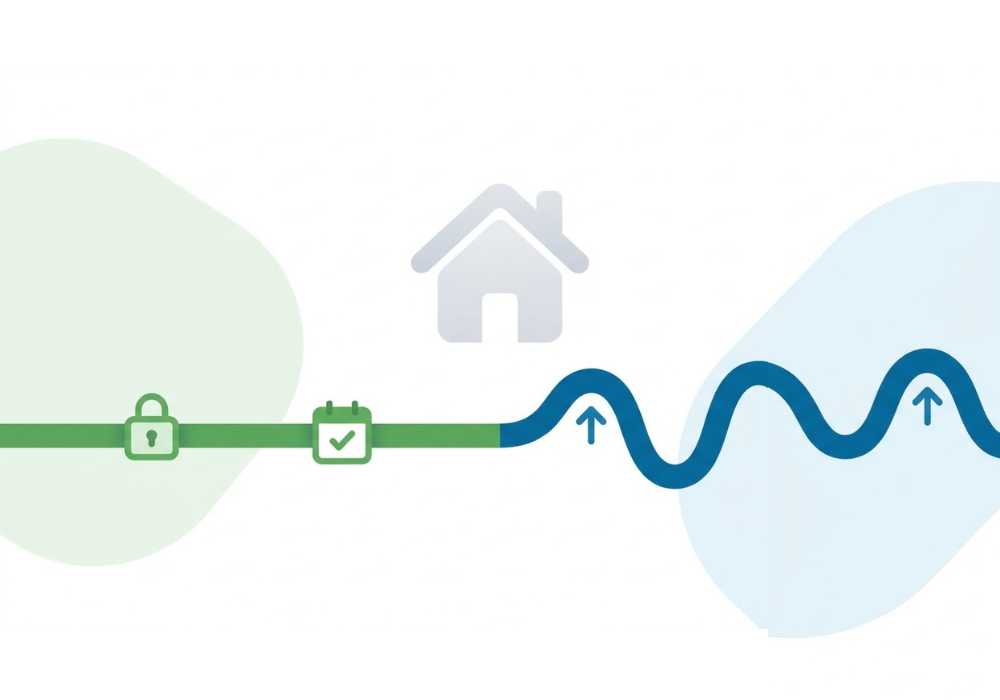
A fixed rate HELOC adds a way to take that risk off the table for part of what you borrow. You draw money from your line, then convert that balance into a fixed-rate portion with its own term and fixed monthly payment. Banks call this a fixed-rate lock, a Fixed-Rate Loan Option or a fixed rate part. The rest of the line stays variable and available to draw.
With a fixed rate HELOC, as you pay down a locked portion, that credit usually becomes available again on the variable side during the draw period, so you keep the flexibility of a line of credit.
Three ways to get a fixed rate on your home equity
“Fixed-rate HELOC” is used loosely, so it helps to know the three structures you will run into.
| Option | How the rate works | How you get money | Best for |
|---|---|---|---|
| Rate-lock option inside a HELOC | Variable line; you lock chosen balances at a fixed rate | Draw as needed, lock some or all | Borrowers who want flexibility plus protection on big draws |
| HELOC with fixed-rate draws | Some online lenders set a fixed rate on each draw | Initial draw at closing, more draws later | Borrowers who want every draw fixed from the start |
| Home equity loan | Fixed rate for the whole loan | One lump sum at closing | A single known cost, such as a roof or debt payoff |
Rate-lock option inside a variable HELOC
This is the most common kind of fixed rate HELOC at large banks. You open a regular HELOC, draw what you need, then ask the lender to lock a specific amount for a term you choose. Each lock becomes a mini installment loan inside your line, with its own fixed rate and payment.
HELOCs with fixed-rate draws
Some online lenders build the fixed rate into the product. Figure, for example, advertises both fixed and variable rate options and a lowest HELOC rate of 7.25% APR as of November 12, 2026. Read the terms closely, because whether later draws get a new fixed rate, and what that rate will be, varies by lender.
Home equity loan
A home equity loan gives you the full amount up front at a fixed rate for the whole term. You pay interest on the entire balance from day one, and there is no credit line to draw from later. The average 10-year home equity loan rate was 8.27% as of November 4, 2026, according to Mortgage Research Center data reported by Fortune, close to the 8.12% average HELOC rate in the same survey. For a full side-by-side, see our HELOC vs home equity loan comparison.
Where to get a fixed rate HELOC option (as of November 2026)
The lenders below publish details about their fixed-rate lock features on their own websites. Terms vary by state and borrower, so confirm with the lender before you apply. For full lender reviews, rates and fees, see our guide to the best HELOC lenders.
| Lender | Feature name | Max locks at once | Minimum per lock | Lock terms | Lock fee |
|---|---|---|---|---|---|
| Bank of America | Fixed-Rate Loan Option | 3 | $5,000 | 1 year up to the account maturity date | No fee to convert |
| U.S. Bank | Fixed-rate option | 3 | $2,000 | 12 to 240 months | No fee to lock, unlock or relock during the draw period |
| PNC (Choice HELOC) | Fixed Rate Part | Not stated | $5,000 | 5 to 30 years (5 to 20 in Tennessee) | Fee each time, waived if set up at origination |
| Citizens | Fixed rate lock | 3 | $5,000 | Set in your agreement | Fees may apply |
Truist also lets HELOC borrowers choose fixed or variable rates, and Figure offers fixed and variable options on its online HELOC. Neither publishes its lock limits on its main HELOC page, so ask for the fixed-rate terms in writing.
A few lenders, such as FourLeaf Federal Credit Union (formerly Bethpage), offer a fixed introductory rate instead. That is different: the rate is fixed only for the intro period, then the whole line turns variable.
What locking really costs
A fixed rate HELOC lock is a trade. You give up some cost and flexibility in exchange for a predictable payment.
- A higher rate on day one. Bank of America states that its Fixed-Rate Loan Option rates are typically higher than its variable HELOC rates, and Citizens says the same about its locks.
- Possible lock fees. Some lenders charge each time you lock. PNC charges a fee per fixed rate part unless you set it up when you open the line, while Bank of America and U.S. Bank advertise no fee to convert.
- A bigger required payment. A locked balance is fully amortized, so you repay principal and interest from the first payment. During the draw period, many variable balances only require interest.
- Limits on how much and how often. Minimum lock amounts and a cap of about three active locks mean you cannot lock every small draw.
- The usual HELOC costs still apply. U.S. Bank, for example, charges a $75 annual fee after the first year unless waived, and an early closure fee of 1% of the line (up to $500) if you close within 30 months.
Fixed vs. variable: a payment example
Here is how a fixed rate HELOC lock compares with staying variable. Say you draw $50,000 for a kitchen remodel and want it paid off in 10 years. The rates below are assumptions for illustration only, based on the November 2026 averages above, not quotes from any lender.
| Scenario | Rate (assumed) | Monthly payment | Total interest over 10 years |
|---|---|---|---|
| Variable, interest-only during the draw period | 8.12% | $338.33 | Principal not reduced |
| Variable, repaid over 10 years, rate never changes | 8.12% | $609.81 | $23,178 |
| Locked for 10 years | 8.27% | $613.79 | $23,655 |
| Variable, rate rises 1 point and stays there | 9.12% | $636.63 | $26,396 |
| Variable, rate falls 1 point and stays there | 7.12% | $583.64 | $20,037 |
In this example, locking costs about $4 a month more than an unchanged variable rate, but it saves about $23 a month if rates climb one point. If rates fall, the variable rate wins. Real rates change gradually, so treat this as a range, not a forecast. To run your own numbers, try our free HELOC payment calculator.
When a fixed-rate lock makes sense
A fixed rate HELOC lock tends to make sense when:
- You are borrowing a large amount for a one-time cost and plan to repay it over several years.
- Your budget cannot absorb a payment that rises if the prime rate goes up.
- Your lender charges no lock fee, so you can lock, and later unlock or relock, at little cost.
- You want a fixed payoff date for a specific project while keeping the rest of the line open for emergencies.
When it probably does not
A lock is usually not worth it if:
- You will repay the balance within a year or two. A short payoff limits how much a rate change can hurt you.
- You draw small amounts often. Minimums and the three-lock cap make locking impractical.
- You need the lowest possible payment right now. Interest-only variable payments are lower in the draw period.
- You want the whole amount at once at a fixed rate. Compare a home equity loan, which may have simpler terms.
How to lock part of your HELOC
- Confirm the feature before you apply. Ask for the lock limits, minimums, terms and fees in writing, since they differ by lender and state.
- Open the HELOC and draw the funds. Some lenders, such as Bank of America and PNC, let you set up a lock at account opening.
- Request a fixed-rate quote. Contact the lender’s rate lock desk or use online banking if offered. Fixed rates are priced on the day you lock.
- Choose the amount and term. A shorter term usually means a higher payment and less total interest.
- Review your new payment. Your statement will show the locked portion and the variable portion separately.
- Know your exit options. Ask whether you can unlock or pay the lock off early, and whether that costs anything.
Pros and cons of a fixed rate HELOC
| Pros | Cons |
|---|---|
| Predictable payment on the locked amount | Fixed rate is usually higher than the variable rate when you lock |
| Protection if the prime rate rises | You miss out if rates fall, unless you can unlock |
| Keeps a flexible line open for other needs | Lock fees at some lenders |
| Paying down a lock frees up credit during the draw period | Higher required payment because principal is repaid right away |
| Can split a big project into separate fixed terms | Usually limited to about three locks with minimum amounts |
Frequently asked questions
Can you convert a HELOC to a fixed rate?
Yes, if your lender offers a rate-lock feature. You choose an outstanding balance, usually at least $2,000 to $5,000, and convert it to a fixed rate for a set term during the draw period. Bank of America, U.S. Bank, PNC and Citizens all describe this option. If your current lender does not offer it, refinancing into a home equity loan is another way to get a fixed rate.
Are fixed HELOC rates higher than variable rates?
Usually, yes. Lenders charge more for the certainty of a fixed rate, and Bank of America and Citizens both state that their fixed lock rates are typically higher than their variable HELOC rates. The gap varies by lender, credit score, loan-to-value ratio and lock term, so compare a lock quote with your current variable rate before you commit.
Can I unlock a fixed-rate HELOC if rates drop?
Some lenders allow it. U.S. Bank lets borrowers unlock and relock a fixed-rate option during the draw period without fees, and PNC also allows unlocking. Other lenders may limit unlocks or charge a fee, so ask before you lock. If unlocking is not allowed, you can still pay off the locked portion early in most cases.
Is a fixed-rate HELOC better than a home equity loan?
It depends on how you will use the money. A HELOC with a fixed-rate option suits borrowers who want a flexible line plus a locked rate on large draws. A home equity loan suits borrowers who need one lump sum, want a single fixed payment and do not need ongoing access to credit. Compare rates, closing costs and fees for both before choosing.
How many fixed-rate locks can I have on a HELOC?
Many large banks cap it at three active locks at a time. Bank of America, U.S. Bank and Citizens each allow up to three, with minimum lock amounts of $2,000 to $5,000. Paying off a lock frees up a slot, so you can lock again later during the draw period if your lender allows it.
Sources
- Bank of America, Home Equity Line of Credit (Fixed-Rate Loan Option disclosures)
- U.S. Bank, HELOC fixed-rate option
- U.S. Bank, Home Equity Line of Credit (rates and fees as of November 9, 2026)
- PNC, Choice Home Equity Line of Credit Fixed Rate Lock
- Citizens, HELOC Disclosures (fixed rate lock disclosure)
- Truist, Home Equity Line of Credit
- Figure, Home Equity Line (rate as of November 12, 2026)
- FourLeaf Federal Credit Union, Home Equity Line of Credit
- Fortune, home equity rates for November 5, 2026 (Mortgage Research Center data as of November 4)
- Prime rate and October 28, 2026 FOMC decision
This article is for educational purposes only and is not financial advice. Rates and terms change often, so confirm details with your lender.


This Post Has One Comment