
Quick answer: In the treasury bills vs CDs comparison, T-bills currently pay more than the average bank CD and are free of state and local income tax, which makes them hard to beat if you live in a high-tax state. A top online CD can match or beat a T-bill on paper, though, and it locks in its rate for longer. Choose T-bills for short-term cash and state-tax savings, and CDs when you want a guaranteed rate for two years or more.
Key takeaways
- As of November 13, 2026, Treasury bills yielded about 4.02% for 4 weeks up to 4.63% for 52 weeks (coupon-equivalent basis).
- The national average 12-month CD was 1.76% in the FDIC’s October 2026 survey, far below T-bills. Top online CDs pay much more than the average.
- T-bill interest is exempt from state and local income tax. CD interest is not.
- Both are about as safe as cash gets: T-bills are backed by the U.S. government, and CDs at insured banks are covered by the FDIC up to $250,000 per depositor, per bank, per ownership category.
How a Treasury bill works
A Treasury bill is a short-term loan to the U.S. government. You buy it for less than its face value, and when it matures you get the full face value. The difference is your interest.
TreasuryDirect sells bills in seven terms: 4, 6, 8, 13, 17, 26 and 52 weeks. The minimum is $100, in $100 steps. Most terms are auctioned every week, and 52-week bills every four weeks. You can buy them directly from the government at TreasuryDirect or through a brokerage account, where they trade like any other security.
How a CD works
A certificate of deposit is a bank account with a fixed rate and a fixed term, from a few months to five years or more. You deposit the money, the bank pays a set rate, and you get it all back at the end. Pull it out early and you’ll usually pay an early withdrawal penalty, often several months of interest.
CDs come from banks and credit unions, so the rate varies a lot from one institution to the next. That’s why the gap between the national average and the best online offers is so wide. Our list of the best-paying CDs tracks the higher end.
Treasury bills vs CDs side by side
| Treasury bills | CDs | |
|---|---|---|
| Who backs it | U.S. government | The bank, plus FDIC insurance (NCUA at credit unions) up to $250,000 |
| Terms | 4 to 52 weeks | A few months to 5+ years |
| Minimum | $100 | Varies; often $0 to $1,000 |
| State and local tax | Exempt | Taxed |
| Getting out early | Sell through a broker at market price | Early withdrawal penalty |
| Rate certainty | Locked only until the bill matures (a year at most) | Locked for the full term, even five years |
Which pays more right now?
As of November 2026, T-bills win by a wide margin against the average CD. On November 13, 2026, the Treasury’s daily bill rates showed coupon-equivalent yields of 4.23% for 13 weeks, 4.47% for 26 weeks and 4.63% for 52 weeks. In the FDIC’s October 2026 survey, the national average 12-month CD paid 1.76%.
On $10,000 for a year, that’s roughly $463 from a 52-week bill versus about $176 from an average-rate CD. The national average includes plenty of big banks that barely compete for deposits, though. A top online CD can pay close to Treasury yields, so the fair fight is a T-bill against the best CD you can find, not the average.
Rates are moving, too. The Federal Reserve held its target range at 3.75% to 4.00% on October 28, 2026, after raising it in September, and its next meeting is December 8 to 9. T-bill yields tend to follow the Fed quickly, while CD rates lag.
The state tax advantage, in numbers
This is where the treasury bills vs CDs decision often gets settled. Because T-bill interest skips state and local income tax, a CD has to pay more just to break even. A rough way to find the CD rate you’d need is to divide the T-bill yield by (1 minus your state tax rate).
| T-bill yield | State tax rate | CD rate needed to match |
|---|---|---|
| 4.47% (26-week) | 5% | about 4.71% |
| 4.47% (26-week) | 9.3% | about 4.93% |
| 4.63% (52-week) | 5% | about 4.87% |
| 4.63% (52-week) | 9.3% | about 5.10% |
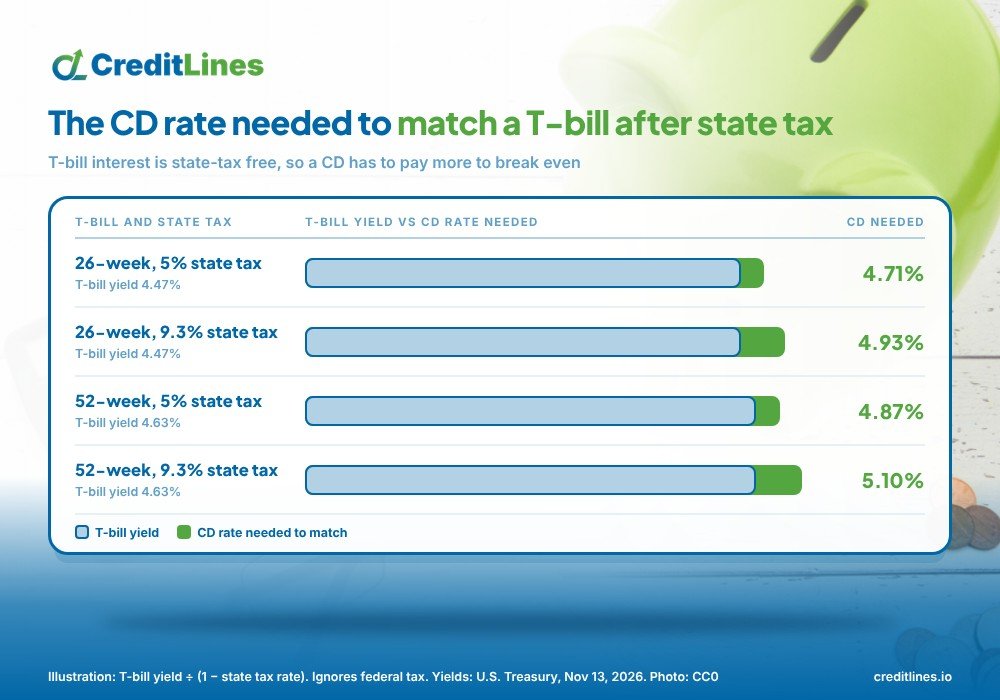
These are illustrations that ignore federal tax (which applies to both) and any state deduction rules. If you live in a state with no income tax, the advantage disappears and you can compare the two rates directly.
Getting your money out early
Neither one is as flexible as a high-yield savings account, but they fail in different ways.
With a CD, the penalty is set in your account agreement, so you know the cost ahead of time. With a T-bill, there’s no penalty, but you have to sell it through a bank or broker at whatever the market will pay. If rates have risen since you bought, you might get a little less than you paid plus interest earned.
TreasuryDirect adds a wrinkle. Bills bought there must be held 45 days before you can sell or transfer them, which means a 4-week bill bought through TreasuryDirect can’t be sold early at all. Bills bought in a brokerage account don’t have that hold.
How to buy a T-bill
If you’ve only ever opened bank accounts, buying a Treasury bill feels unfamiliar the first time. It takes about 15 minutes either way.
- Pick where to buy. Open a TreasuryDirect account with your Social Security number and bank details, or use a brokerage account you already have.
- Choose the term. Match it to when you’ll need the money. A 26-week bill for a down payment due next summer, a 4-week bill for cash you might need soon.
- Place a non-competitive bid. This simply means you accept whatever rate the auction sets. Almost every individual buyer does this.
- Decide about reinvesting. You can have the bill roll into a new one automatically at maturity, or have the money sent back to your bank.
On auction day, the price is set and your account is debited. When the bill matures, the full face value lands in your account.
Ladders: spreading your money across dates
A ladder works the same way with either product. Instead of putting $20,000 into one term, you split it, say four pieces of $5,000 maturing at different times. Some of your money is always coming due, and you’re not betting everything on today’s rate.
With T-bills, a ladder usually stays within a year, so it’s best for cash with a known spending date. With CDs, you can stretch a ladder to five years, which protects more of your savings if rates fall. Many savers end up using both: T-bills for the next 12 months of planned spending, CDs for money they won’t touch for longer.
What about money market funds? Many of them invest heavily in Treasury bills, so their yields tend to track T-bills and you can usually withdraw any day. They aren’t FDIC insured, and fund-level tax treatment varies, so check the fund’s details before treating it as a CD substitute.
Treasury bills vs CDs: which one should you pick?
T-bills usually make more sense if:
- You live in a state with a meaningful income tax.
- You’re parking money for under a year, such as a house down payment or a tax bill.
- You have more than $250,000 to park and don’t want to split it across banks for FDIC coverage.
A CD usually makes more sense if:
- You want to lock today’s rate for two, three or five years in case rates fall.
- You live in a state with no income tax and you’ve found a CD that pays more than T-bills.
- You’d rather keep everything at your bank and skip a brokerage account.
If you’re torn, you don’t have to choose just one. Splitting cash between a short T-bill and a longer CD gives you the state tax break on money you’ll need soon and a locked rate on money you won’t. Revisit the split each time something matures, since the gap between the two moves with every Fed decision.
Who shouldn’t use either for this money: anyone without an emergency fund. Keep a few months of expenses somewhere you can reach the same day, then put the rest to work.
Frequently asked questions
Are T-bills safer than CDs?
Both are very safe. Treasury bills are backed by the full faith and credit of the U.S. government. CDs at FDIC-insured banks are covered up to $250,000 per depositor, per bank, per ownership category, and credit union CDs have similar NCUA coverage. The practical difference is that T-bills have no coverage cap, which matters if you’re parking a large sum.
Do you pay taxes on Treasury bill interest?
Yes, at the federal level. T-bill interest is subject to federal income tax but exempt from state and local income tax. The interest is the difference between your purchase price and the face value, and it’s reported for the year the bill matures or is sold. TreasuryDirect or your broker sends a tax form.
Can you lose money on a Treasury bill?
Not if you hold it to maturity. You’ll receive the full face value. You can lose a little if you sell before maturity and rates have risen since you bought, because the bill’s market price will have dropped. Holding to maturity avoids that risk entirely.
Should I buy T-bills at TreasuryDirect or through a broker?
TreasuryDirect has no fees and sells directly at auction, but its website is basic and bills must be held 45 days before you can sell or transfer them. Most large brokerages let you buy T-bills at auction or on the secondary market with no commission, and you can sell any time. Choose based on convenience.
Do T-bills automatically renew like CDs?
They can. Both TreasuryDirect and most brokers let you schedule automatic reinvestments, sometimes called rolling, into a new bill when the old one matures. Unlike many CDs, there’s no grace period to remember, but the new bill gets whatever rate the next auction sets, which could be higher or lower.
Sources
- U.S. Treasury, Daily Treasury Bill Rates (November 2026)
- TreasuryDirect, Treasury Bills
- TreasuryDirect, Selling a Treasury Marketable Security (45-day hold)
- FDIC, National Rates and Rate Caps (October 2026)
- Federal Reserve, FOMC statement (October 28, 2026)
- FDIC, Deposit Insurance
This article is for educational purposes only and is not financial advice. Rates change daily, so check current yields before you buy.