
Quick answer: Medical debt on credit report files is far less common than it used to be, but it can still appear in 2026. The three credit bureaus no longer report paid medical collections, collections that started under $500, or unpaid bills less than a year old in collections. The CFPB rule that would have banned medical debt from credit reports entirely was struck down in July 2025, so larger unpaid medical collections can still show up unless your state forbids it.
Key takeaways
- Paid medical collections should not be on your report at all, and neither should ones that started below $500.
- Unpaid medical collections can’t appear until they’ve been in collections for a year.
- As of October 2026, 15 states and Washington, D.C., have their own laws limiting medical debt reporting.
- A medical bill you put on a regular credit card or a medical credit card isn’t medical debt to the bureaus. It reports like any other card balance.
What changed, and when
Most of the protection you have today comes from a voluntary policy, not a law. Equifax, Experian and TransUnion announced it in two stages:
- July 1, 2022: paid-off medical collections stopped being included on credit reports, and the waiting period before an unpaid medical collection could appear went from six months to one year.
- April 2023: medical collections with an initial reported balance under $500 were removed. The bureaus said that brought the share of medical collection accounts taken off reports to nearly 70%.
A bigger change almost happened. In January 2025, the CFPB finalized a rule that would have kept medical debt off credit reports and stopped lenders from using it. It never took effect. On July 11, 2025, a federal court in the Eastern District of Texas vacated the rule at the joint request of the CFPB and the industry groups that sued, finding it went beyond the Bureau’s authority under the Fair Credit Reporting Act.
Can medical debt on credit report files still hurt you?
Yes, if it’s large enough, old enough and unpaid. A $2,400 ER bill that went to collections 14 months ago and hasn’t been paid can legally sit on your report in most states, and it can drag your score down the way any collection would.
How much it hurts depends on the scoring model your lender uses. Under FICO Score 9, paid third-party collections, including medical, no longer count against you, and unpaid medical collections carry less weight than other collections. Many lenders still use older FICO versions, though, so don’t count on the gentler treatment.
Two kinds of medical bills are treated as ordinary debt, not medical debt:
- Bills you paid with a credit card. Once it’s on your Visa, it’s a card balance. Missed payments report as late card payments.
- Medical credit cards and payment plans run by lenders. These report like any other credit account, including late payments.
That’s worth knowing before you agree to move a hospital bill onto a card just to make the collector stop calling. You may be trading a protected debt for an unprotected one.
States that limit medical debt reporting
As of October 2026, according to the National Consumer Law Center’s tracker as compiled by MoneyGeek, these states have laws that bar or limit medical debt on credit reports:
| State | Effective |
|---|---|
| Colorado | August 2023 |
| New York | December 2023 |
| Virginia | April 2024 |
| Connecticut | July 2024 |
| New Jersey (debts under $500 only) | July 2024 |
| Minnesota | October 2024 |
| California | January 2025 |
| Illinois | January 2025 |
| Rhode Island | July 2025 |
| Vermont | July 2025 |
| Washington | July 2025 |
| Maine | September 2025 |
| Maryland | October 2025 |
| Delaware | October 2025 |
| Oregon | January 2026 |
| Washington, D.C. | August 2026 |
These laws are under pressure. In October 2025 the CFPB issued an interpretive rule saying the Fair Credit Reporting Act generally preempts state credit reporting laws, and industry groups have sued Colorado and Minnesota over theirs. The state laws remain on the books while those cases play out, so if you live in one of these states, it’s still worth citing your state’s law in a dispute.
Is this medical collection allowed on your report?
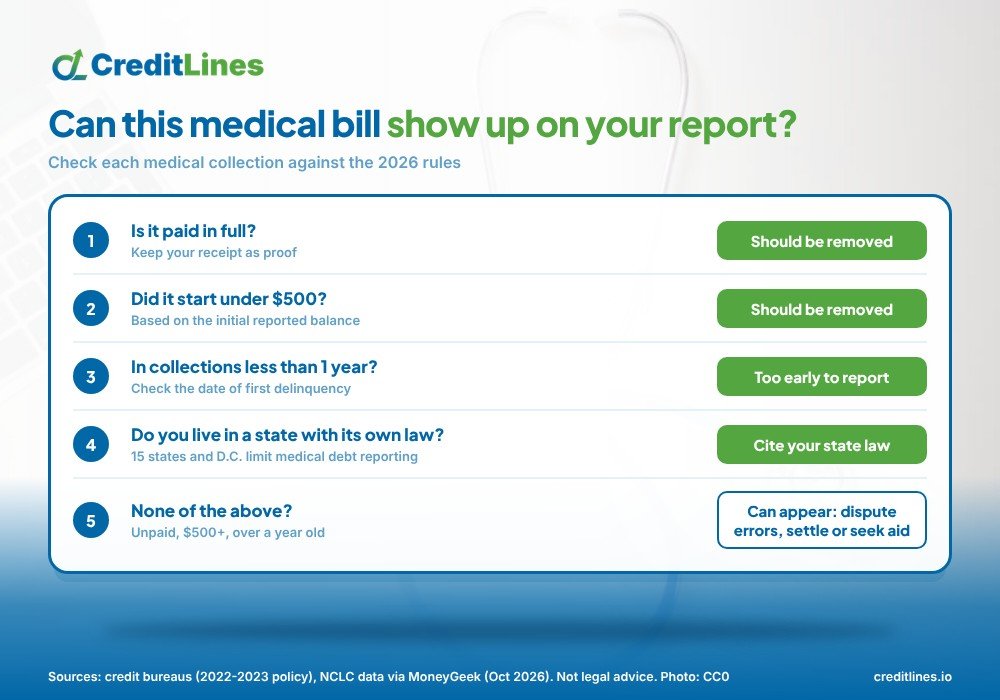
The fastest way to check medical debt on credit report files is to pull your reports from all three bureaus at AnnualCreditReport.com before you call anyone. Then check each medical collection against these questions:
- Is it paid? If you’ve paid it in full, it should be gone. Dispute it with each bureau that still shows it, and include proof of payment.
- Was the original balance under $500? It shouldn’t be there. Dispute it.
- Has it been in collections for less than a year? It’s too early to report. Dispute it and point to the date of first delinquency.
- Do you live in a state on the list above? Your state law may bar it. Mention the law in your dispute.
- Is the amount or the account itself wrong? Billing errors on medical accounts are common, and insurance often hasn’t been applied. Ask the provider for an itemized bill and an explanation of benefits from your insurer before you pay a cent.
If none of these apply, the collection is probably reportable. That doesn’t mean you’re stuck with it, but the path changes from disputing to negotiating.
An example: which of these bills can show up?
Say you live in a state without its own medical debt law and you pull your reports in November 2026. You find three medical collections. Here’s how the current rules sort them:
| Bill | Status | Can it be on your report? |
|---|---|---|
| $320 urgent care visit | Unpaid, in collections 2 years | No. It started under $500. |
| $1,800 imaging bill | Unpaid, in collections 8 months | Not yet. It hasn’t hit the one-year mark. |
| $2,400 ER visit | Unpaid, in collections 14 months | Yes, unless it’s wrong or you pay it. |
| $2,400 ER visit, paid last month | Paid in full | No. Paid medical collections are removed. |
This is an illustration, not legal advice for your situation. The point is that most medical debt on credit report files today shouldn’t be there, and the one that legitimately can be is often the easiest to fix: settle or pay it, or get it reduced through financial assistance, and it drops off.
How to get medical collections removed
Start with disputes for anything that fails the checks above. The bureaus generally have 30 days to investigate, and anything they can’t verify has to come off. Our guide to the three credit reporting agencies walks through how to file a dispute with each one.
Keep each dispute short and specific: name the account, say which rule it breaks (paid, under $500, under a year old, or barred by your state), and attach proof such as a payment receipt or an itemized bill. File it online or by certified mail so you have a record of the date.
For a valid collection, you still have options:
- Pay it, or settle it. Because paid medical collections are dropped from reports, paying a valid one should get it removed. Get the payoff or settlement terms in writing first, and keep the receipt.
- Apply for hospital financial assistance, even after the fact. Nonprofit hospitals must have a written financial assistance policy under IRS rules, and they generally have to give you a chance to apply before taking extraordinary collection actions, which include reporting you to a credit bureau. If you qualify, the bill can be reduced or wiped out.
- Ask for a payment plan with the provider directly. If the account is still with the hospital and hasn’t gone to collections, a plan can keep it off your report while you pay.
For everything else on your report, from late payments to old charge-offs, our step-by-step guide on how to repair your credit yourself covers the full process.
What to watch out for
Don’t pay a credit repair company to do any of this. Everything above is free to do yourself, and federal law bars those companies from charging before they’ve done the work.
Be careful with old debts, too. Making a payment on a very old medical debt can restart the clock for a lawsuit in some states, even though the credit reporting timeline doesn’t change. If a collector contacts you about a bill you don’t recognize, ask for written validation before you pay anything.
And keep an eye on your score once medical collections come off. If it doesn’t move, something else is weighing on it. Our guide on how to improve your credit score covers the factors that usually matter more.
Frequently asked questions
How long does medical debt stay on your credit report?
An unpaid medical collection that’s allowed on your report can stay for up to seven years from the date the account first became delinquent, the same as other collections. Under the bureaus’ current policy, it disappears sooner if you pay it, because paid medical collections are no longer included on credit reports.
Does paying off medical debt raise your credit score?
Usually, yes. Paid medical collections are removed from your credit reports, so the negative mark goes away entirely rather than just showing a zero balance. How many points you gain depends on the rest of your report. If other negatives remain, the jump may be smaller than you expect.
Can a hospital report me to the credit bureaus?
A hospital or the collection agency it hires can report an unpaid bill once it has been in collections for a year, if the original balance was $500 or more and your state doesn’t bar it. Nonprofit hospitals generally must give you a chance to apply for financial assistance before reporting you.
Is medical debt in collections the same as a late credit card payment?
No. A medical collection is a separate collection account reported by a collector, and it follows the bureaus’ special medical debt rules. A medical bill paid with a credit card becomes card debt, so missing a card payment reports as a late payment with no medical protections.
Will the medical debt rules change again?
Possibly. Bills in Congress would ban medical debt from credit reports nationwide, more states are considering their own laws, and courts are still deciding whether existing state laws are preempted by federal law. Check your reports and your state’s rules at least once a year.
Sources
- Equifax, Experian and TransUnion joint press release on medical collections under $500 (April 11, 2023)
- CFPB, Prohibition on Creditors and Consumer Reporting Agencies Concerning Medical Information (Regulation V), vacatur notice
- Federal Register, Fair Credit Reporting Act; Preemption of State Laws (October 28, 2025)
- myFICO, FICO Score versions (FICO Score 9 treatment of medical collections)
- MoneyGeek, Medical debt credit reporting bans by state (NCLC data, updated November 2026)
- IRS, Financial assistance policy and emergency medical care policy, Section 501(r)(4)
- AnnualCreditReport.com, free credit reports
This article is for educational purposes only and is not financial advice or legal advice. Credit reporting rules and state laws are changing, so check the current rules for your state.

