
Quick answer: To start investing in stocks in 2026, open a brokerage or retirement account, choose a low-cost diversified fund like an S&P 500 index fund as your core holding, decide how much you can invest regularly, and set up automatic contributions so you keep buying through the market’s ups and downs. You can begin with as little as $1 thanks to fractional shares. The most important move is simply to start early and stay invested, because time in the market matters far more than trying to pick the perfect moment.
If you have been waiting to start investing, you are not alone, and 2026 has given plenty of reasons to hesitate. The market keeps hitting record highs, valuations look stretched, and prices have been swinging. This guide walks you through exactly how to begin, step by step, and answers the question quietly holding a lot of beginners back: is now even a good time to start?
Is 2026 a good time to start investing in stocks?
Here is the honest answer: no one can reliably tell you what the market will do this year, and that is precisely why you should not try to time it. As of mid-2026, the S&P 500 has climbed to record territory, pushing past 7,600 for the first time and rising roughly 9% for the year, powered largely by the boom in artificial intelligence spending. At the same time, valuations are historically high, and Wall Street disagrees sharply on what comes next, with some banks forecasting further gains and others warning of a pullback.
When professional forecasters disagree this much, it tells you something important: short-term market direction is unpredictable, even for experts. Trying to wait for the “right” moment usually means sitting in cash while the market drifts higher, or freezing up entirely.
The approach that has worked for ordinary investors over decades is different and simpler:
Focus on time in the market, not timing the market. You are investing for years or decades, not for next month. Over long periods, the U.S. stock market has trended upward through recessions, crashes, and record highs alike.
Invest steadily, no matter the headlines. Buying a fixed amount on a regular schedule, known as dollar-cost averaging, means you automatically buy more shares when prices are low and fewer when they are high, smoothing out the bumps.
Match your money to your timeline. Money you need within a few years should not be in stocks at all. Money you will not touch for five-plus years can ride out volatility.
So yes, 2026 can be a fine time to start, as long as you invest money you will not need soon and you commit to staying invested. Now let’s get into the how.
Step 1: Build your financial foundation first
Before you buy a single share, make sure the base is solid. Investing works best when you are not forced to sell at a bad time to cover an emergency.
Two things to handle first:
An emergency fund. Set aside three to six months of essential expenses in a savings account. This keeps a surprise car repair or job loss from derailing your investments.
High-interest debt. If you are carrying credit card debt at 20% or more, paying it down is effectively a guaranteed return that beats what stocks are likely to earn. Tackle that first.
With a cushion in place and expensive debt under control, you can invest with confidence instead of anxiety.
Step 2: Choose the right account
You do not buy stocks directly from the market. You buy them through an investment account. The account you choose matters, mostly because of taxes.
| Account type | Best for | Key feature |
|---|---|---|
| 401(k) | Anyone with an employer match | Free money if your employer matches contributions, so capture this first |
| Roth IRA | Most beginners investing for retirement | You contribute after-tax money and qualified withdrawals in retirement are tax-free |
| Traditional IRA | Those wanting a tax break now | Contributions may be tax-deductible, withdrawals taxed later |
| Taxable brokerage account | Goals other than retirement, or after maxing retirement accounts | No contribution limits and no withdrawal restrictions |
A simple order of priority for most beginners: if your employer offers a 401(k) match, contribute at least enough to get the full match first, because that is an immediate 100% return on those dollars. After that, a Roth IRA is a popular choice for retirement money because your growth comes out tax-free later. Use a regular taxable brokerage account for goals before retirement or once you have filled up the tax-advantaged options.
Step 3: Decide what to actually invest in
This is where beginners often get stuck, imagining they need to pick winning stocks. You do not. In fact, trying to is one of the most common ways new investors lose money.
The simplest, most durable approach is to build your core around low-cost, diversified funds rather than individual stocks:
Index funds and ETFs hold hundreds or thousands of companies at once. An S&P 500 index fund, for example, gives you a slice of 500 of the largest U.S. companies in a single purchase. When you own the whole index, you do not need any one company to succeed.
Low fees matter enormously. A fund’s expense ratio is an annual fee taken as a percentage of your investment. Broad index funds often charge a fraction of a percent, and lower fees mean more of your money stays invested and compounding.
Individual stocks can be part of your plan later, but treat them as a small, optional slice once your diversified core is in place. For most people starting out, a broad index fund or two is genuinely enough.
Step 4: Figure out how much to start with
You need far less than most people think. The old barrier of needing hundreds of dollars to buy a single share is gone. Most major brokers now offer fractional shares, letting you buy a piece of a fund or stock for as little as $1.
What matters is not the starting amount but the habit. Even $25 to $50 a month, invested consistently, builds a meaningful balance over time. Decide on an amount you can comfortably invest every month without straining your budget, and treat it like a recurring bill to yourself.
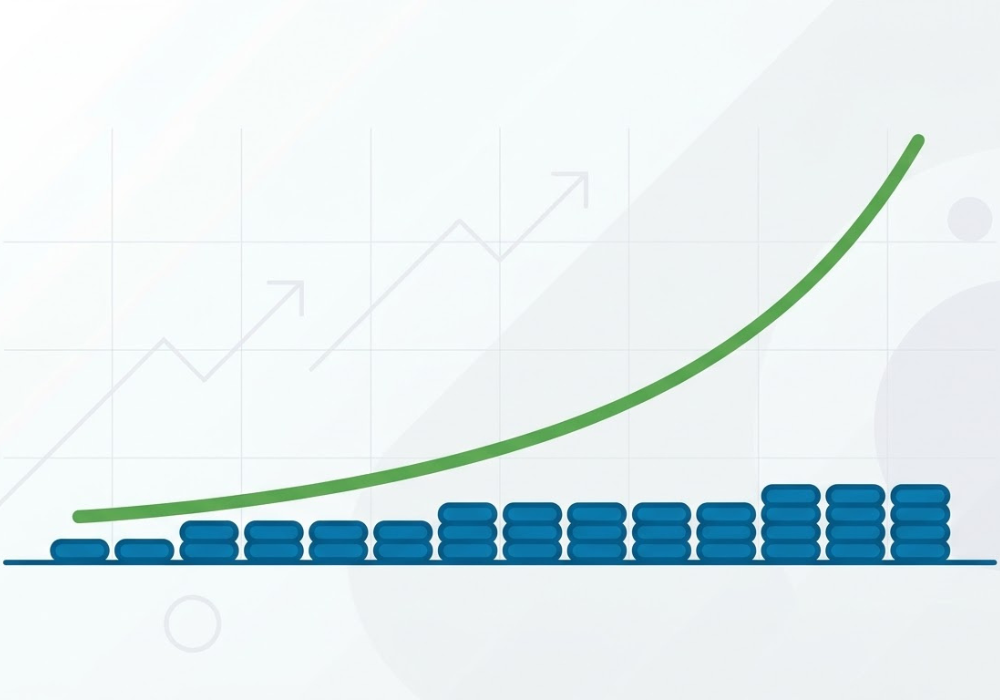
This is where the real magic happens. Because of compounding, the returns your money earns start earning their own returns. Consider a simplified, hypothetical example: investing $300 a month at a 7% average annual return would grow to roughly $366,000 after 30 years, even though you would have contributed only about $108,000 of your own money. Markets never return a smooth 7% year after year, so treat this as an illustration of the shape, not a promise. The lesson is that the gap between what you put in and what you accumulate widens dramatically the longer you stay invested, which is why starting early beats almost everything else.
Step 5: Open your account and place your first order
Opening an account takes about the same effort as setting up online banking. You will need your Social Security number, some basic personal information, and a way to fund the account, such as a bank transfer.
Several large, well-known brokers are commonly used by beginners, including Fidelity, Charles Schwab, Robinhood, and E*TRADE. Most offer commission-free stock and ETF trades and easy-to-use apps. Rather than agonizing over the choice, pick one that feels intuitive to you. You can always switch later, and the differences matter less than simply getting started.
Once your account is funded, placing your first order is straightforward. Open the order ticket and fill in a few fields:
Symbol (ticker). Enter the trading symbol of the fund or stock you want, for example the ticker for an S&P 500 ETF.
Quantity. Choose how many shares, or a dollar amount if you are using fractional shares.
Order type. A market order buys at the current price and is fine for long-term investors. A limit order lets you set a maximum price you are willing to pay.
Review and submit. Confirm the details and place the order.
That’s it. You are now an investor.
Step 6: Automate it and leave it alone
The single best thing you can do after your first purchase is to make investing automatic and then resist the urge to tinker. Set up automatic recurring contributions, weekly or monthly, so you keep buying regardless of what the market or the news is doing. This removes emotion and willpower from the equation, which is exactly where most investors go wrong.
Then, largely leave it alone. Checking your balance daily and reacting to every dip is a recipe for panic selling. A better rhythm is to review your plan once or twice a year, rebalance if needed, and otherwise let time and compounding do the work.
Common beginner mistakes to avoid
Trying to time the market. Waiting for a dip or a “safe” moment usually costs more than it saves. Consistent investing beats prediction.
Panic selling in a downturn. Selling when prices fall locks in losses. Volatility is the normal price of long-term returns.
Chasing hot stocks or trends. The stock everyone is talking about is often already expensive. A boring index fund usually wins over time.
Ignoring fees. High expense ratios and trading costs quietly erode returns. Favor low-cost funds.
Investing money you will need soon. Anything you need within a few years does not belong in stocks.
Never starting. The most expensive mistake of all is waiting for the perfect moment that never comes.
Frequently asked questions
How much money do I need to start investing in stocks? Very little. Thanks to fractional shares, many brokers let you start with as little as $1, and even $25 to $50 a month invested consistently can grow significantly over time. The habit matters more than the starting amount.
Is 2026 a good time to start investing in stocks? It can be, if you are investing money you will not need for at least five years and you commit to investing regularly. Because short-term market moves are unpredictable, staying invested over the long term matters more than picking the perfect entry point.
What should a beginner invest in first? Most beginners are best served by a low-cost, diversified fund such as an S&P 500 index fund or a broad-market ETF, which spreads your money across hundreds of companies at once. Individual stocks can come later as a small, optional part of your portfolio.
Should I open a Roth IRA or a regular brokerage account? If you are investing for retirement, a Roth IRA is a popular choice because qualified withdrawals are tax-free. Use a taxable brokerage account for goals before retirement or after you have maxed out tax-advantaged accounts. If your employer offers a 401(k) match, capture that first.
What is dollar-cost averaging? It means investing a fixed amount on a regular schedule regardless of price. You automatically buy more shares when prices are low and fewer when they are high, which smooths out volatility and removes the temptation to time the market.
How do I actually buy a stock or fund? Open and fund a brokerage account, open the order ticket, enter the ticker symbol, choose a quantity or dollar amount, select a market or limit order, and submit. Most brokers charge no commission on stock and ETF trades.
This article is for educational purposes only and is not financial or investment advice. Investing in stocks involves risk, including the potential loss of principal, and past performance does not guarantee future results. Any figures are hypothetical illustrations, not promises of return. Consider your own situation and consult a licensed financial professional before investing.
