
Quick answer: A Nasdaq index fund tracks a Nasdaq index, usually the Nasdaq-100, which holds the 100 largest non-financial companies on the Nasdaq and is heavily weighted toward technology and growth, or the broader Nasdaq Composite, which holds thousands of stocks. The most popular is the Invesco QQQ Trust (QQQ), with an expense ratio of 0.18%, while the newer Invesco Nasdaq 100 ETF (QQQM) tracks the same index at a lower 0.15% and is better for long-term holding. For broad Composite exposure, Fidelity’s ONEQ or FNCMX work well. These funds have delivered strong returns but are concentrated in a handful of big tech names, making them more volatile than an S&P 500 fund. You invest through one of these funds via a brokerage, since you cannot buy an index directly.
The Nasdaq is home to the biggest names in technology and high-growth investing, and a Nasdaq index fund is the simplest way to own a slice of them all in a single purchase. But not all Nasdaq funds are the same, the differences in index, cost, and structure matter, and there is one big risk every investor should understand first. This guide breaks down the best Nasdaq index funds in 2026, how they differ, and how to invest.
What is a Nasdaq index fund?
A Nasdaq index fund is a fund, usually an ETF or mutual fund, that tracks the performance of a Nasdaq stock index. Instead of buying individual Nasdaq stocks yourself, you buy one fund and gain exposure to the whole index at once, with the fund handling the holdings and rebalancing.
One key point up front: you cannot invest in a Nasdaq index directly, because an index is just a measurement, not an investable asset. To put money into the Nasdaq, you buy a fund that tracks it. And the first thing to decide is which Nasdaq index you want to follow.
Nasdaq-100 vs. Nasdaq Composite
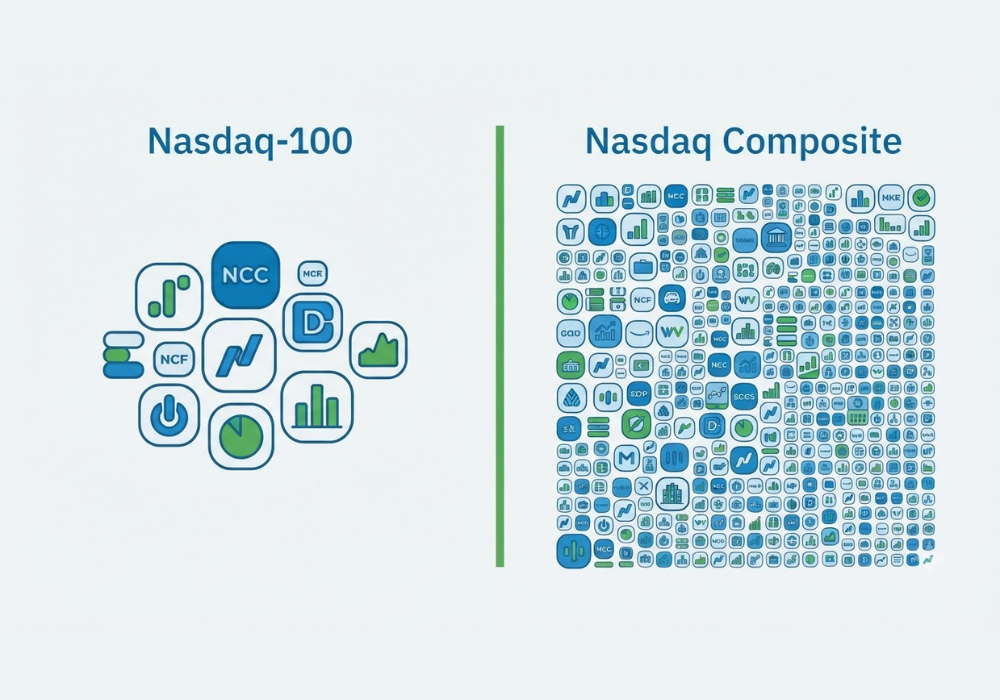
There are two main Nasdaq indexes, and knowing the difference is essential to choosing the right fund.
| Feature | Nasdaq-100 | Nasdaq Composite |
|---|---|---|
| Holdings | The 100 largest non-financial companies on the Nasdaq | Thousands of stocks listed on the Nasdaq |
| Includes financial companies? | No | Yes |
| Company sizes | Large-cap | Large, mid, and small cap |
| Concentration | High, very tech-heavy | Tech-heavy but slightly broader |
| Popular funds | QQQ, QQQM | ONEQ, FNCMX |
When most people say “Nasdaq index fund,” they mean a fund tracking the Nasdaq-100, which holds the 100 biggest non-financial companies on the exchange and is dominated by technology and growth giants. The Nasdaq Composite is much broader, covering thousands of companies of all sizes listed on the Nasdaq, so a Composite fund gives you deeper diversification and less concentration in the largest tech names.
The best Nasdaq index funds in 2026
Here are the leading options, spanning both indexes and both fund types. Expense ratios are annual costs, and figures reflect 2026, so verify current details before investing.
| Fund | Index tracked | Expense ratio | Type | Best for |
|---|---|---|---|---|
| Invesco QQQ Trust (QQQ) | Nasdaq-100 | 0.18% | ETF | Popularity and high liquidity |
| Invesco Nasdaq 100 ETF (QQQM) | Nasdaq-100 | 0.15% | ETF | Low-cost, long-term buy-and-hold |
| Fidelity Nasdaq Composite ETF (ONEQ) | Nasdaq Composite | 0.21% | ETF | Broad exposure beyond the top 100 |
| Fidelity Nasdaq Composite Fund (FNCMX) | Nasdaq Composite | 0.29% | Mutual fund | Broad exposure with no minimum |
| Direxion Nasdaq-100 Equal Weight (QQQE) | Nasdaq-100, equal weight | 0.35% | ETF | Reducing concentration in the biggest stocks |
Invesco QQQ Trust (QQQ)
QQQ is the original and by far the most popular Nasdaq-100 fund, one of the most heavily traded ETFs in the world, with an expense ratio of 0.18% and hundreds of billions in assets. Its enormous trading volume makes it a favorite of active traders and options traders who value liquidity. For most investors, it is the default name associated with “investing in the Nasdaq.”
Invesco Nasdaq 100 ETF (QQQM)
QQQM tracks the exact same Nasdaq-100 index as QQQ but charges a lower 0.15% expense ratio, which makes it the smarter pick for long-term, buy-and-hold investors. The small cost difference compounds meaningfully over decades, so if you are investing for the long run rather than trading frequently, QQQM generally wins.
Fidelity Nasdaq Composite ETF (ONEQ)
ONEQ tracks the broader Nasdaq Composite rather than just the top 100, giving you exposure to more than a thousand companies across large, mid, and small caps. That broader reach means more diversification and less concentration in the biggest tech names, at a 0.21% expense ratio.
Fidelity Nasdaq Composite Index Fund (FNCMX)
FNCMX is the mutual fund version of broad Composite exposure, with no minimum investment required and a 0.29% expense ratio. It suits investors who prefer mutual funds, for example inside a retirement account that offers it.
Direxion Nasdaq-100 Equal Weight (QQQE)
QQQE holds the same 100 companies as QQQ but weights each roughly equally rather than by size, which reduces the dominance of the largest few stocks. It carries a higher 0.35% expense ratio, and equal-weight funds tend to lag cap-weighted ones in strong tech-led bull markets, but it is a tool for investors worried about concentration.
QQQ vs. QQQM: which should you choose?
This is the most common question, and the answer is simple. Both funds track the identical Nasdaq-100 index, so their holdings and performance are essentially the same. The difference is cost and use case. QQQM is cheaper at 0.15% versus 0.18%, making it the better choice for long-term buy-and-hold investors. QQQ has far higher trading volume and liquidity, making it better for active traders and anyone using options. If you are simply investing for the long haul, QQQM is usually the smarter, lower-cost pick.
A caution on leveraged Nasdaq funds
While researching, you will encounter funds like ProShares UltraPro QQQ (TQQQ) advertising “3x” the Nasdaq-100. These are leveraged ETFs, not plain index funds, and they are a different and far riskier product. They aim to multiply daily returns using derivatives, carry a much higher expense ratio around 0.82%, and are designed for short-term trading, not buy-and-hold investing, where they can suffer severe losses and decay over time. Beginners building a long-term portfolio should stick with standard funds like QQQM or QQQ and avoid leveraged products.
The big risk: concentration
Here is the most important thing to understand about Nasdaq-100 funds. They are highly concentrated. Just seven stocks drive roughly 40% of the Nasdaq-100, and the fund is heavily tilted toward a handful of mega-cap technology companies. That concentration is a double-edged sword: it has powered outsized gains when big tech soars, but it also means a downturn in a few giant stocks can drag the whole fund down hard.
This is why a Nasdaq-100 fund is more volatile than a broad S&P 500 fund, and why it should usually be one part of a diversified portfolio rather than your only holding. If concentration concerns you, a Composite fund or an equal-weight fund spreads the risk somewhat.
Nasdaq index fund performance
The track record has been strong. QQQ has delivered annualized returns above 20% over the past decade, and the Nasdaq Composite posted three straight years of 20%-plus gains, rising 43.4% in 2023, 28.6% in 2024, and 20.3% in 2025. That reflects the powerful run in technology and growth stocks.
But two cautions apply. Past performance does not predict future results, and those strong returns come with higher volatility and sharper drawdowns than the broader market. A Nasdaq fund can fall faster than an S&P 500 fund when growth stocks stumble, so your time horizon and risk tolerance matter.
Nasdaq index fund vs. S&P 500
A common question is whether to choose a Nasdaq fund or an S&P 500 fund. The Nasdaq-100 is narrower, more tech-heavy, and more volatile, with higher growth potential and higher risk. The S&P 500 is broader, spanning 500 large companies across all sectors, making it a more diversified core holding. Many investors own both, using an S&P 500 fund as their foundation and a Nasdaq fund to tilt toward technology and growth. Neither is strictly better, they serve different roles.
How to invest in a Nasdaq index fund
- Open a brokerage or retirement account, which most major brokerages offer with no fees to buy these funds.
- Choose your fund based on your goal, such as QQQM for low-cost long-term Nasdaq-100 exposure or ONEQ for the broader Composite.
- Buy shares like any stock or fund, and consider automatic recurring investments to dollar-cost average.
- Reinvest dividends to compound over time.
- Hold for the long term and keep the fund as part of a diversified portfolio rather than your only investment.
Pros and cons of Nasdaq index funds
The upside:
- Exposure to leading technology and growth companies in a single fund.
- Strong historical returns, outpacing broader indexes over many periods.
- Low cost, with the best funds charging around 0.15% to 0.21%.
- Simplicity and diversification compared with picking individual stocks.
The trade-offs:
- Heavy concentration in a few mega-cap tech stocks.
- Higher volatility than a broad S&P 500 fund.
- Sector risk, since a tech downturn hits the fund hard.
- Leveraged versions are dangerous for long-term investors.
Frequently asked questions
What is a Nasdaq index fund?
A Nasdaq index fund is a fund that tracks a Nasdaq index, usually the Nasdaq-100 or the broader Nasdaq Composite. It lets you invest in many Nasdaq companies through a single ETF or mutual fund, since you cannot buy an index directly, and it is heavily weighted toward technology and growth.
What is the best Nasdaq index fund?
For long-term investors, the Invesco Nasdaq 100 ETF (QQQM) is often the best pick, tracking the Nasdaq-100 at a low 0.15% expense ratio. QQQ is the most popular and liquid option, while Fidelity’s ONEQ or FNCMX offer broader Nasdaq Composite exposure. The best choice depends on your goals.
What is the difference between the Nasdaq-100 and the Nasdaq Composite?
The Nasdaq-100 tracks the 100 largest non-financial companies on the Nasdaq, while the Nasdaq Composite tracks thousands of stocks of all sizes listed on the exchange. The Composite is broader and more diversified, while the Nasdaq-100 is more concentrated in large tech companies.
Should I buy QQQ or QQQM?
Both track the same Nasdaq-100 index, so performance is nearly identical. QQQM is cheaper at 0.15% and better for long-term buy-and-hold investors, while QQQ has higher liquidity and suits active traders and options users. For most long-term investors, QQQM is the smarter, lower-cost choice.
Are Nasdaq index funds a good investment?
They can be, offering exposure to top technology and growth companies with strong historical returns at a low cost. However, they are concentrated in a few mega-cap tech stocks and more volatile than a broad S&P 500 fund, so they work best as part of a diversified portfolio rather than your only holding.
Is the Nasdaq-100 better than the S&P 500?
Neither is strictly better. The Nasdaq-100 is narrower, more tech-heavy, and more volatile, with higher growth potential and risk, while the S&P 500 is broader and more diversified. Many investors hold both, using the S&P 500 as a core and a Nasdaq fund to add growth exposure.
What about leveraged Nasdaq funds like TQQQ?
Leveraged funds like TQQQ aim to multiply the Nasdaq-100’s daily returns using derivatives and carry a much higher expense ratio. They are risky, short-term trading tools, not plain index funds, and can decay and suffer severe losses over time, so long-term investors should avoid them.
This article is for educational and informational purposes only and is not financial or investment advice, and any funds mentioned are examples, not recommendations. Investing involves risk, including possible loss of principal, and past performance does not predict future results. Expense ratios and figures reflect 2026 and change over time. Verify current fund details and consider consulting a licensed financial professional before investing.