Quick answer: A crypto coin scam is any scheme that tricks you into sending cryptocurrency, or buying a worthless token, to someone who has no intention of giving it back. The most common types in 2026 are fake investment platforms (often called “pig butchering”), rug pulls on new coins, impersonation scams that push victims to crypto ATMs, fake giveaways using AI deepfakes, wallet drainers, and “recovery” scams that target people who’ve already lost money. According to the FBI, Americans reported $11.37 billion in crypto-related fraud losses in 2025, more than half of all cybercrime losses. The biggest warning signs are guaranteed returns, pressure to act fast, a stranger who brings up crypto, being told to pay at a crypto ATM, and “fees” or “taxes” you must pay before you can withdraw. If you’ve been scammed, stop sending money, save every record, contact your exchange right away, and report it at ic3.gov and reportfraud.ftc.gov.
Crypto scams aren’t a fringe problem anymore. They’re the single most expensive form of fraud in the United States. And they don’t just hit crypto traders. Many victims had never bought a coin until a scammer walked them through it, step by step, with patience and kindness that felt completely real. This guide explains how today’s crypto coin scams work, how to check whether a coin or platform is legitimate, and exactly what to do if it’s already happened to you or someone you love.
How big is the crypto scam problem?
The FBI’s 2025 Internet Crime Report, released in April 2026, shows how fast this has grown:
| 2025 FBI IC3 data | Figure |
|---|---|
| Crypto-related complaints | 181,565 |
| Crypto-related losses | $11.37 billion, a record |
| Share of all reported cybercrime losses | More than half of $20.9 billion |
| Losses to crypto investment fraud alone | $7.2 billion, the largest single category |
| Average reported loss per crypto complaint | About $62,600 |
| Crypto ATM complaints and losses | 13,460 complaints, $389 million in losses |
| Complaints mentioning AI | More than 22,000, with $893 million in losses |
Older Americans are hit hardest. People 60 and over reported $7.8 billion in losses across all internet crime types in 2025, up 59% from the year before, and crypto ATMs have become a favorite tool for scammers targeting them.
And these are only the reported numbers. Many victims never file a report out of embarrassment, so the real total is almost certainly higher.
The 9 most common crypto coin scams in 2026
1. Fake investment platforms (“pig butchering”)
This is the costliest crypto scam in America. It starts with a “wrong number” text, a dating app match, or a friendly stranger on social media or LinkedIn. Over weeks or months, the scammer builds a real-feeling relationship, then casually mentions how much they’re making trading crypto and offers to show you how.
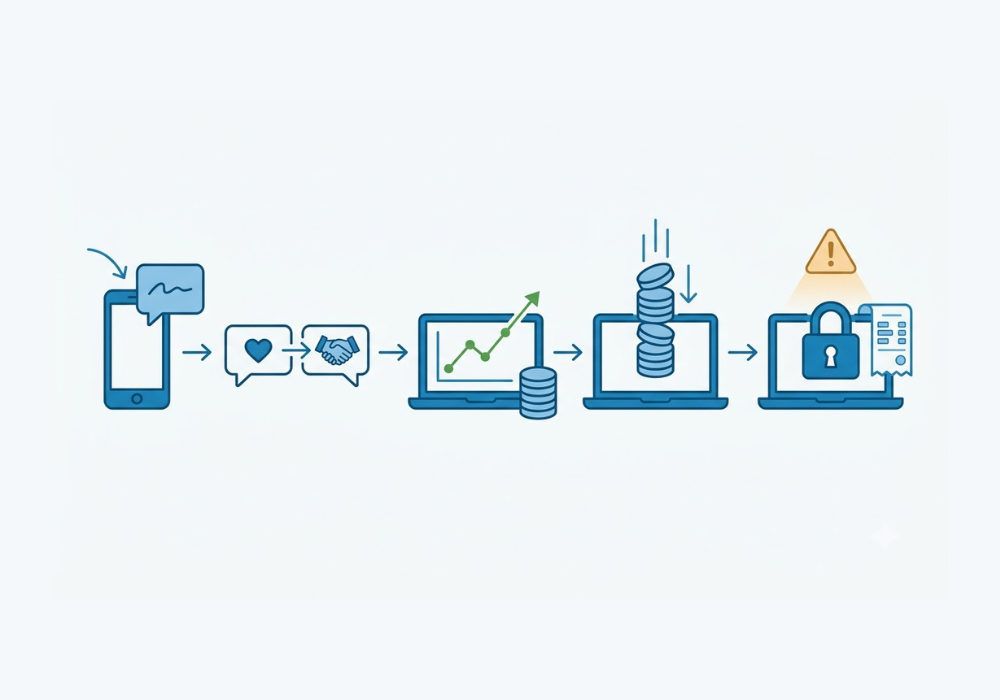
They send you to a professional-looking trading website or app that the scammers control. Your first small deposit seems to grow fast, and you may even be allowed to withdraw a little to build trust. Then you invest more, often savings, retirement money, or a home equity loan. When you try to cash out, you’re told you owe “taxes,” a “verification fee,” or an “unlock deposit” first. Paying it just leads to another fee. The balance on the screen was never real.
The FBI has traced many of these operations to organized criminal groups in Southeast Asia, particularly Cambodia, Laos, and Burma.
2. Rug pulls and fake tokens
Anyone can create a new crypto coin in minutes. In a rug pull, the creators hype a new token on social media, in Telegram groups, or through paid influencers. The price rockets as buyers pile in, and then the developers dump their huge supply or pull all the money out of the trading pool, leaving the token worthless.
A close cousin is the honeypot token, a coin coded so you can buy it but can’t sell it. You watch the price climb on the chart with no way out.
3. Impersonation scams that end at a crypto ATM
A caller claims to be from your bank’s fraud department, the IRS, Social Security, the police, Amazon, or Microsoft tech support. They say your account was hacked or you owe a fine, and the only way to “protect” your money is to withdraw cash and deposit it into a crypto ATM, often by scanning a QR code they send you.
No real bank, government agency, or business will ever ask you to pay with crypto or move money to “keep it safe.” Crypto kiosks are especially dangerous because once the cash goes in, it’s nearly impossible to get back.
4. Fake giveaways and AI deepfakes
A video shows a famous billionaire or crypto founder promising to send back double whatever you send. These days the video, and even a live stream, may be an AI deepfake. Real people and real companies don’t do “send 1, get 2 back” giveaways. Ever.
5. Romance scams
Closely tied to pig butchering, these build an online romantic relationship first. Eventually there’s an emergency, a business opportunity, or a “can’t-lose” investment that requires crypto. Warning signs include someone who’s never able to video chat or meet in person and who steers every conversation toward money.
6. Phishing and wallet drainers
Fake websites, apps, browser extensions, and airdrop offers trick you into entering your wallet’s seed phrase or approving a malicious transaction. A single click on “connect wallet” and “approve” can give a wallet drainer permission to empty your account, sometimes days later.
Address poisoning is a newer trick. Scammers send a tiny transaction from an address that looks almost identical to one you use often, hoping you’ll copy the wrong address from your history next time you send funds.
7. Task and job scams
You’re offered easy remote work “rating apps,” “boosting products,” or “optimizing orders.” Early tasks pay small amounts in crypto. Then you’re told you must deposit your own crypto to unlock bigger, better-paying task sets, and that money disappears.
8. Pump-and-dump schemes
Promoters secretly buy a small, cheap coin, then flood social media and chat groups with hype to drive the price up. When regular buyers jump in, the promoters sell everything, and the price crashes.
9. Recovery scams
This one hits people when they’re most vulnerable. After you’ve lost money, someone contacts you, or advertises online, claiming to be a lawyer, a “blockchain forensics” firm, or even a government agency that can recover your crypto for an upfront fee. They can’t. It’s a second scam. Government agencies don’t charge to investigate your case, and no legitimate firm can guarantee recovery.
How to tell if a crypto coin is a scam
Before you buy a newer or lesser-known coin, run it through this checklist. One red flag isn’t always proof of fraud, but several together should stop you.
| Check | Healthy sign | Red flag |
|---|---|---|
| Who’s behind it | Named, verifiable team with a real track record | Anonymous team, stolen photos, fake LinkedIn profiles |
| Promises | Talks about risk honestly | Guaranteed returns, “can’t lose,” “100x” |
| Where it trades | Listed on major, regulated U.S. exchanges | Only on obscure exchanges or one unknown platform |
| Token ownership | Supply spread across many holders | A few wallets hold most of the supply |
| Liquidity | Trading pool is locked or deep | Developers can pull the money anytime |
| Can you sell? | Others are selling normally on the blockchain | Lots of buys, almost no successful sells (possible honeypot) |
| Marketing | Organic community and real use case | Paid influencer blitz, countdown timers, “last chance” pressure |
| Documents | Clear white paper and audited code | Copied white paper, no audit, vague purpose |
| Website and app | Real domain, app in official app stores | Look-alike domain, app only by download link |
A simple test: search the coin or platform name plus “scam” or “reviews,” and check the CFTC’s and your state securities regulator’s warning lists. You can also look up whether a platform is registered with FinCEN as a money services business, though registration alone doesn’t prove legitimacy.
If you want exposure to crypto, the safest path is sticking with established assets, like those covered in our guide to the top cryptocurrencies, bought on regulated U.S. platforms.
The red flags that show up in almost every crypto scam
- A stranger, new friend, or romantic interest introduces you to crypto.
- Guaranteed or unusually high returns, like “2% a day” or “double your money.”
- Pressure and urgency: “today only,” “don’t tell your bank,” “keep this between us.”
- You’re told to pay with crypto, a crypto ATM, gift cards, or a wire to “protect” your money.
- You must pay fees, taxes, or deposits before withdrawing. Real platforms deduct fees from your balance.
- Someone asks for your seed phrase or private key. No legitimate person or company ever needs it.
- You’re coached on what to tell your bank or told to lie about why you’re withdrawing cash.
- The platform can only be reached through a link a contact sent you, not through an official app store.
How to protect yourself from crypto scams
- Never share your seed phrase or private keys, with anyone, for any reason.
- Use well-known, regulated U.S. exchanges and type the web address yourself instead of clicking links.
- Turn on two-factor authentication with an authenticator app or hardware key, not text messages.
- Move long-term holdings to a wallet you control, like a hardware wallet. Our crypto exchange vs. wallet guide explains the trade-offs.
- Double-check every wallet address character by character, and send a small test amount first for large transfers.
- Review and revoke token approvals you no longer need, using a reputable token-approval checker for your blockchain.
- Hang up and call back using a number you look up yourself whenever someone claims to be from your bank, the government, or a company.
- Talk to someone you trust before sending money, especially if you’ve been told to keep it secret.
- Set up a trusted contact on your brokerage and bank accounts, and help older relatives do the same.
What to do if you’ve been scammed
Act fast. The first few hours matter most.
- Stop all payments. Don’t send any more money, including “fees” to unlock your funds or pay a recovery service.
- Contact the exchange or platform you sent funds from immediately and report the fraud. If the scammer’s address belongs to a regulated exchange, the exchange may be able to freeze the funds.
- If you sent money from a bank, call your bank’s fraud line right away. Wire transfers can sometimes be stopped if reported quickly. The FBI’s Recovery Asset Team froze $679 million in 2025 through its Financial Fraud Kill Chain process.
- Save everything: wallet addresses, transaction IDs (hashes), screenshots, websites, usernames, phone numbers, emails, and chat logs. Don’t delete the conversation.
- Report it to the FBI at ic3.gov. Include transaction hashes and wallet addresses.
- Report it to the FTC at ReportFraud.ftc.gov, and file with your state attorney general and local police.
- If a crypto ATM was involved, report it to the kiosk operator using the number on your receipt, and check your state’s rules. Some states now require refunds for fraud victims in certain cases.
- Secure your accounts. Change passwords, move any remaining crypto to a new wallet with a new seed phrase, and check for unknown devices or token approvals.
- Beware of recovery scams. Anyone who contacts you offering to get your money back for a fee is almost certainly running another scam.
- Talk to a tax professional. IRS guidance in 2025 indicated that some victims of investment scams may be able to deduct losses as theft losses, depending on the facts. Our crypto taxes guide has more on how crypto losses are treated.
Being scammed is not a sign of being foolish. These operations are run by organized, well-funded criminal groups that do this full time. Reporting helps investigators connect cases and, sometimes, recover money.
New protections in 2026: the crackdown on crypto ATMs
States are moving quickly to rein in crypto kiosks:
- Indiana became the first state to ban crypto ATMs outright in March 2026, and Tennessee followed with its own statewide ban.
- About 30 states have passed crypto kiosk laws since 2023, according to AARP, and 13 of those laws passed in 2026.
- Common protections now include daily transaction limits, fraud warning signs on machines, printed receipts, operator licensing, and, in some states, refunds for fraud victims. South Dakota, for example, caps transactions at $1,000 a day and requires full refunds for fraud victims.
These laws reduce how much can be lost per transaction, but they can’t stop every scam. If anyone tells you to put cash into a crypto ATM, treat it as a scam until proven otherwise. Our crypto regulation guide covers the broader rule changes affecting crypto in 2026.
Frequently asked questions
What is a crypto coin scam?
A crypto coin scam is any scheme that tricks you into sending cryptocurrency or buying a worthless token. Common examples include fake investment platforms, rug pulls on new coins, impersonation scams that push you to crypto ATMs, fake giveaways, wallet drainers, and recovery scams targeting past victims.
How can I tell if a crypto coin is a scam?
Watch for anonymous developers, guaranteed returns, heavy influencer hype, a few wallets holding most of the supply, unlocked liquidity, and trading only on obscure platforms. If people can buy the token but almost no one can sell, it may be a honeypot designed to trap your money.
How much money do Americans lose to crypto scams?
According to the FBI’s 2025 Internet Crime Report, Americans reported $11.37 billion in crypto-related fraud losses in 2025, more than half of all reported cybercrime losses. Crypto investment fraud alone accounted for $7.2 billion.
Can you get your money back after a crypto scam?
Sometimes, but it’s rare. Your best chance is to act within hours: contact your exchange and bank, save transaction records, and report to ic3.gov and the FTC. Be wary of anyone charging upfront fees to recover your crypto, since that’s usually a second scam.
Where do I report a crypto scam?
Report it to the FBI at ic3.gov and the FTC at ReportFraud.ftc.gov. Also notify the exchange or crypto ATM operator you used, your bank if money came from your account, your state attorney general, and local police.
Is it safe to use a crypto ATM?
Crypto ATMs aren’t scams by themselves, but scammers use them heavily because deposits are nearly impossible to reverse. Never use one because someone on the phone or online told you to. No real bank, agency, or company will ask you to pay or protect money through a crypto ATM.
What is a pig butchering scam?
It’s a long-con investment scam. A stranger builds trust over weeks through texts, dating apps, or social media, then guides you to a fake crypto trading platform. Your account seems to grow, but when you try to withdraw, you’re asked for fees, and the money is gone.
This article is for educational and informational purposes only and is not legal, tax, or investment advice. Scam tactics evolve quickly, and statistics cited reflect the FBI’s 2025 Internet Crime Report and state laws reported as of 2026. If you believe you’ve been scammed, contact your financial institution, report to ic3.gov and ReportFraud.ftc.gov, and consider speaking with a licensed attorney or tax professional.