
Quick answer: House insurance, also called homeowners insurance, protects your home’s structure, your belongings, and your finances if someone is injured on your property. A standard policy covers six things: your dwelling, other structures, personal property, loss of use, personal liability, and medical payments. In 2026, the average U.S. homeowner pays roughly $2,500 a year, though costs range from about $1,450 to over $5,300 depending on coverage and location. One critical point: standard house insurance does not cover floods or earthquakes, which require separate policies, and you should size your dwelling coverage to what it would cost to rebuild your home, not its market value.
Your home is likely the most valuable thing you own, and house insurance is what stands between a disaster and financial ruin. But premiums have jumped in recent years, and many homeowners are either overpaying or, worse, dangerously underinsured without realizing it. This guide breaks down exactly what house insurance covers, what it costs in 2026, how much you actually need, and how to keep the price down without leaving yourself exposed.
What is house insurance?
House insurance, known formally as homeowners insurance and often called home insurance, is a policy that protects you financially against damage to your home and belongings, and against liability if someone is hurt on your property. If a covered event like a fire or storm damages your house, your insurer helps pay to repair or rebuild it.
Beyond peace of mind, there is a practical reason nearly every homeowner has it: mortgage lenders require it. As long as you have a loan on your home, your lender will insist you carry house insurance to protect their investment, and yours.
What does house insurance cover?
A standard homeowners policy, known as an HO-3 policy, includes six core types of coverage. Understanding them helps you see exactly what you are paying for.
| Coverage | What it protects |
|---|---|
| Dwelling (Coverage A) | The physical structure of your home |
| Other structures (Coverage B) | Detached structures like a garage, fence, or shed |
| Personal property (Coverage C) | Your belongings, such as furniture and electronics |
| Loss of use (Coverage D) | Extra living costs if your home is uninhabitable after a claim |
| Personal liability (Coverage E) | Legal and medical costs if you injure someone or damage their property |
| Medical payments (Coverage F) | Minor injuries to guests, regardless of fault |
These coverages protect against a range of perils, typically including fire, windstorms, hail, lightning, theft, vandalism, and certain types of water damage from inside the home. The structure itself is usually covered on an open-perils basis, meaning anything not specifically excluded is covered.
What house insurance does NOT cover
This is where homeowners get caught off guard, so read carefully. Standard house insurance excludes several major risks:
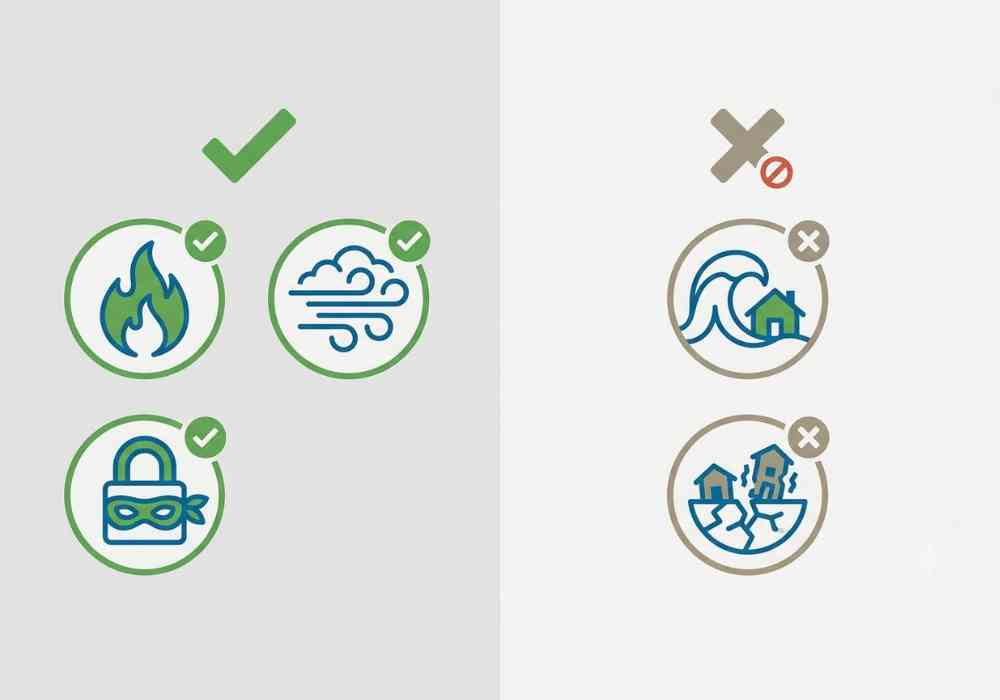
- Flood damage. Floods are never covered by a standard policy. You need separate flood insurance, often through the National Flood Insurance Program, which is essential if you live in a flood-prone area.
- Earthquake damage. Also excluded, requiring a separate earthquake policy or endorsement.
- Wear and tear, maintenance, and neglect. Insurance covers sudden, accidental events, not the gradual deterioration of an aging roof or unmaintained home.
- Pests and infestations, such as termites or rodents.
- High-value items above your limits. Expensive jewelry, art, or collectibles may exceed standard personal property limits and need a special endorsement, sometimes called a rider or floater.
- Certain wind or hurricane damage in some coastal areas, which may require a separate windstorm policy.
The flood and earthquake gaps are the most important to know, because the homeowners who need that coverage most often assume they already have it.
How much does house insurance cost in 2026?
The average cost of house insurance in the U.S. is roughly $2,500 a year for a typical policy with around $300,000 in dwelling coverage, though estimates vary by methodology. Depending on your coverage amount and where you live, costs range from about $1,450 to more than $5,300 annually. The more dwelling coverage you carry, the higher your premium, and doubling your coverage can push the cost toward $6,000 in higher-cost scenarios.
Where you live is the single biggest factor, largely because of weather risk.
| Cost tier | Example states | Approximate annual cost |
|---|---|---|
| Cheapest | Hawaii, Vermont, Delaware | About $900 to $1,400 |
| National average | Nationwide | About $2,500 |
| Most expensive | Florida, Louisiana, Texas | About $5,000 to $6,000 or more |
States exposed to hurricanes, wildfires, tornadoes, and hail carry the highest premiums, while states with mild weather and low disaster risk are the cheapest. Florida sits at the top, with some averages exceeding $6,000 a year, while Hawaii and Vermont are among the lowest.
Why house insurance costs are rising in 2026
If your premium jumped at renewal, you are not alone. Rates have climbed sharply over the past few years, and although the pace is slowing in some regions, costs are still rising in 2026. Several forces are driving this:
- Higher construction and material costs. Rebuilding a home costs more than it used to, thanks to inflation and supply-chain disruptions, so insurers must pay more on claims.
- More frequent and severe weather. Hurricanes, wildfires, and severe storms have grown more costly, increasing insurer losses.
- Rising reinsurance costs. The insurance that insurers themselves buy has become more expensive, and that gets passed on.
- Insurer pullback in high-risk areas. In states like Florida and California, some insurers have limited new policies or stopped renewing existing ones, reducing competition and raising prices.
Because insurers apply increases at renewal, many homeowners are still seeing the effects roll in throughout 2026.
How much house insurance do you need?
This is where getting it right matters most, and where a common mistake can leave you underinsured. Your dwelling coverage should equal the cost to rebuild your home, not its market value.
Market value includes your land, neighborhood, and local real estate trends, none of which insurance covers. Insurance covers rebuilding the structure. Depending on your area, the rebuild cost can be higher or lower than what your home would sell for. A home worth $420,000 on the market might cost $510,000 to rebuild with current materials and labor, and if you insured it for the market value, you would be badly short after a total loss.
Beyond dwelling coverage, aim for these guidelines:
- Personal property: typically 50% to 70% of your dwelling coverage.
- Personal liability: at least $300,000, and $500,000 or more if you have significant assets, with an umbrella policy for extra protection.
- Replacement cost, not actual cash value. Choose replacement cost coverage, which pays to replace damaged items at today’s prices, rather than actual cash value, which deducts for depreciation and pays far less.
Types of homeowners policies
Most single-family homeowners have an HO-3 policy, the standard. But there are others worth knowing:
- HO-3: the most common policy for single-family homes.
- HO-5: a premium policy with broader coverage, often for newer or higher-value homes.
- HO-6: for condo owners.
- HO-4: renters insurance, for tenants.
- HO-8: for older homes where rebuild cost exceeds market value.
How to save on house insurance
You can lower your premium without gutting your coverage:
- Compare quotes from several insurers. Rates vary widely, so shopping around is the most effective way to save.
- Bundle home and auto with the same insurer for a discount.
- Raise your deductible. A higher deductible lowers your premium, as long as you can afford the out-of-pocket amount if you file a claim.
- Harden your home. Security systems, updated roofing, storm shutters, and water leak sensors can earn discounts.
- Ask about every discount, including claims-free, new-home, and loyalty discounts.
- Do not underinsure to save money. Cutting coverage below your rebuild cost is a false economy that can cost you everything after a major loss.
How to choose and buy a policy
- Estimate your rebuild cost, not your market value, to set your dwelling coverage.
- Set your coverage limits, including personal property, liability, and replacement cost coverage.
- Add any needed extras, such as flood or earthquake insurance or riders for valuables.
- Compare quotes from multiple insurers for the same coverage.
- Check financial strength and claims reputation, since a cheap policy is worthless if the insurer handles claims poorly.
- Bundle and review annually, adjusting your coverage as your home’s value and your belongings change.
Frequently asked questions
What does house insurance cover?
A standard house insurance policy covers your dwelling, other structures, personal property, loss of use, personal liability, and medical payments. It protects against perils like fire, wind, hail, theft, and certain water damage, but not floods or earthquakes.
How much does house insurance cost in 2026?
The average is roughly $2,500 a year for about $300,000 in dwelling coverage, though costs range from about $1,450 to over $5,300 depending on coverage and location. Florida and Louisiana are among the most expensive, while Hawaii and Vermont are among the cheapest.
Does house insurance cover floods?
No. Standard house insurance never covers flood damage. You need a separate flood insurance policy, often through the National Flood Insurance Program, which is essential if you live in a flood-prone area. Earthquakes are also excluded and require separate coverage.
How much house insurance do I need?
Your dwelling coverage should equal the cost to rebuild your home, not its market value, since insurance does not cover your land. Aim for personal property around 50% to 70% of your dwelling coverage and liability of at least $300,000, and choose replacement cost coverage.
Why did my house insurance go up in 2026?
Premiums are rising due to higher construction and material costs, more frequent and severe weather, rising reinsurance costs, and insurers pulling back in high-risk states. These affect entire markets, so increases often are not tied to anything you did.
Is house insurance required?
It is not legally required, but mortgage lenders require it as long as you have a home loan. Even without a mortgage, it is strongly recommended, since it protects your most valuable asset from catastrophic loss.
How can I lower my house insurance cost?
Compare quotes from several insurers, bundle home and auto, raise your deductible, add security and weather-resistance features, and ask about every available discount. Avoid underinsuring your home just to cut the premium, since that leaves you exposed.
This article is for educational purposes only and is not insurance or financial advice. Coverage terms, exclusions, and costs vary by insurer, policy, and location, and change over time. Any figures reflect 2026 estimates that differ by source and methodology. Review a policy’s actual terms and compare quotes, and consider consulting a licensed insurance agent before buying coverage.

This Post Has One Comment