
Quick answer: In the U.S., the IRS taxes cryptocurrency as property, not currency, so you owe tax in two situations. You pay capital gains tax when you dispose of crypto by selling it, trading one coin for another, or spending it, and you pay ordinary income tax when you earn crypto through staking, mining, rewards, or payment. Crypto held one year or less is taxed at your regular income rate, while crypto held longer than a year gets lower long-term rates of 0%, 15%, or 20%. Simply buying and holding crypto, or moving it between your own wallets, is not taxable. The big change in 2026 is that exchanges now report your activity to the IRS on Form 1099-DA, so accurate reporting is no longer optional.
For years, crypto taxes lived in a grey area, with patchy reporting and limited IRS visibility. That era is over. As of 2026, U.S. exchanges send your gains and losses directly to the IRS, the same way a stockbroker reports your trades, and mismatches with your return get flagged automatically. This guide explains exactly how crypto is taxed, what counts as a taxable event, the forms you need, the new reporting rules, and legal ways to lower your bill.
How is crypto taxed in the US?
The foundation of everything is one IRS rule: cryptocurrency is treated as property, similar to stocks or real estate. That classification, in place since 2014, determines how every transaction is taxed. It leads to two distinct kinds of tax.
Capital gains tax applies when you dispose of crypto. Your gain or loss is the difference between what you sold it for and your cost basis, meaning what you originally paid.
Ordinary income tax applies when you earn crypto. The value of the crypto when you receive it counts as income at your regular tax rate.
Understanding which category a transaction falls into is the key to getting your taxes right, so let’s break down what triggers each.
What counts as a taxable event
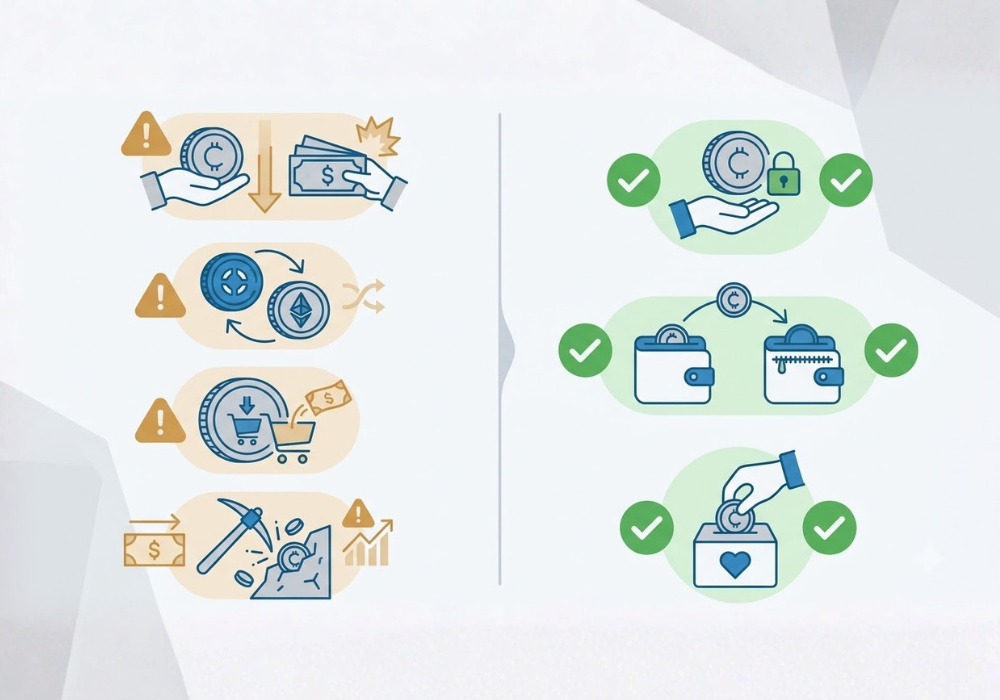
A taxable event is any transaction where you owe tax. Many people wrongly assume this only happens when they cash out to dollars. In reality, several common actions trigger tax:
- Selling crypto for cash. The classic disposal, producing a capital gain or loss.
- Trading one crypto for another. Swapping Bitcoin for Ethereum is a taxable disposal of the Bitcoin, even though no cash changed hands. This is the one that surprises people most.
- Spending crypto on goods or services. Using crypto to buy something is treated as selling it first, so it is a taxable disposal.
- Earning crypto. Receiving crypto from staking, mining, airdrops, rewards, or as payment is taxable income at its fair market value when you receive it.
What is NOT taxable
Just as important is knowing what does not trigger tax. These actions are generally tax-free:
- Buying crypto with cash and holding it. Purchasing and simply holding is not a taxable event, no matter how much the price rises on paper.
- Transferring crypto between your own wallets. Moving your own coins from one wallet or exchange to another is not a sale.
- Gifting crypto, within annual gift limits.
- Donating crypto to a qualified charity, which can actually provide a tax deduction.
The pattern is simple: you are taxed when you dispose of crypto or earn it, not when you buy, hold, or move your own coins.
Capital gains tax on crypto
When you dispose of crypto at a profit, how much you owe depends on how long you held it.
| Holding period | Tax treatment | 2026 rate |
|---|---|---|
| One year or less (short-term) | Taxed as ordinary income | 10% to 37% |
| More than one year (long-term) | Long-term capital gains | 0%, 15%, or 20% depending on income |
| Collectible NFTs held long-term | Collectibles rate | Up to 28% |
The takeaway is powerful: holding crypto for more than a year before selling can dramatically cut your tax rate, since short-term gains are taxed at your full income rate while long-term gains top out at 20% for most assets. Your exact long-term rate depends on your taxable income and filing status.
If you sell at a loss, that loss is not wasted. Losses offset your capital gains, and if your losses exceed your gains, you can deduct up to $3,000 against ordinary income per year and carry the rest forward to future years.
Income tax on crypto you earn
When you earn crypto rather than buy it, the rules are different. Mining, staking rewards, airdrops, interest, and crypto received as payment are all taxed as ordinary income, valued at the fair market value on the day you gain control of the coins. This income is taxed at your regular rate of 10% to 37%.
There is a second step people forget. Once you have paid income tax on earned crypto, that value becomes your cost basis. If you later sell it, you have a separate capital gains event based on how the price moved since you received it. So earned crypto can be taxed twice in effect: once as income when you get it, and again as a capital gain or loss when you dispose of it.
The big 2026 change: Form 1099-DA
The most important development for 2026 is new reporting. Starting with transactions after 2025, all centralized U.S. exchanges and brokers must report your crypto activity to the IRS on a new form, Form 1099-DA, and send a copy to you.
This mirrors how stockbrokers already report equity trades. For 2026, gross-proceeds reporting is mandatory for digital assets, and cost basis reporting is phasing in for certain covered assets. The practical consequences are significant:
- The IRS now has your data. It can automatically cross-reference what your exchange reported against what you put on your return, and mismatches get flagged.
- The grey area is gone. Vague or incomplete crypto reporting is far riskier than in past years.
- The 1040 question is mandatory. Every taxpayer must answer the digital asset question on Form 1040, regardless of how small their activity was.
Wallet-by-wallet cost basis
Alongside 1099-DA, the IRS now requires cost basis to be tracked on a per-wallet or per-account basis, rather than pooling everything together across all your platforms. This means you must know the specific basis of the coins in each wallet or exchange when you sell them. If you use multiple wallets and exchanges, keeping clean, separated records is now essential.
The catch: your 1099-DA may be incomplete
Do not assume Form 1099-DA is the whole story. The cost basis it reports can be incomplete, especially for crypto you transferred in from another platform or a self-custodied wallet, where the exchange may not know what you originally paid. If the reported basis is wrong or missing, you could overpay or underpay.
Form 1099-DA does not replace your obligation to track and report your own transactions accurately. Review it carefully against your own records and reconcile any differences before you file.
The forms you’ll need
Reporting crypto usually involves a few IRS forms:
| Form | What it is for |
|---|---|
| Form 8949 | Reporting each crypto sale or disposal, with proceeds, basis, and gain or loss |
| Schedule D | Summarizing your total capital gains and losses |
| Schedule 1 | Reporting certain crypto income |
| Schedule C | Reporting crypto income from self-employment or a business, such as mining as a business or getting paid as a contractor |
| Form 1040 | Answering the digital asset question, required for every filer |
How to report crypto on your taxes, step by step
- Gather your records from every exchange and wallet you used during the year, including your new Form 1099-DAs.
- Determine your cost basis for each asset using a consistent method, tracked wallet by wallet.
- Categorize each transaction as a short-term gain or loss, a long-term gain or loss, or ordinary income.
- Reconcile against your 1099-DAs, correcting any incomplete or missing basis with your own records.
- Complete Form 8949 and Schedule D for your disposals, and report earned crypto as income on Schedule 1 or Schedule C.
- Answer the digital asset question on Form 1040 honestly, and file.
Given the complexity, many investors use crypto tax software to import transactions and generate these forms, or work with a CPA who specializes in digital assets.
Cost basis methods
Your cost basis method affects your gains. The default is often FIFO, or first in, first out, which assumes you sold your oldest coins first. If your records support it, specific identification lets you choose which coins you sold, which can reduce your taxable gain. Whatever method you use, apply it consistently and keep documentation.
Ways to legally lower your crypto taxes
You can reduce what you owe with a few legitimate strategies:
- Hold for more than a year. This shifts gains from your ordinary income rate to the lower long-term rate, often the single biggest lever.
- Harvest your losses. Selling losing positions to offset gains cuts your tax bill. Notably, as of 2026 crypto is not subject to the wash-sale rule that applies to stocks, so you can sell at a loss and rebuy immediately, though this could change in the future.
- Donate appreciated crypto. Giving long-held, appreciated crypto to a qualified charity can provide a deduction while avoiding capital gains tax.
- Use your losses fully. Offset gains first, then deduct up to $3,000 against ordinary income and carry forward the rest.
- Consider tax-advantaged accounts. Holding crypto exposure inside a retirement account can shelter gains from annual taxation.
Common crypto tax mistakes to avoid
- Assuming tax only applies when you cash out. Crypto-to-crypto trades and spending are taxable too.
- Not tracking cost basis. Poor records make accurate reporting nearly impossible and can lead to overpaying.
- Relying only on your 1099-DA. It may be incomplete, so reconcile it with your own data.
- Ignoring small transactions. They still count, and the IRS now has the data.
- Skipping the 1040 digital asset question. Everyone must answer it.
Frequently asked questions
How is crypto taxed in the US?
The IRS treats crypto as property. You owe capital gains tax when you sell, trade, or spend it, and ordinary income tax when you earn it through staking, mining, rewards, or payment. Crypto held over a year gets lower long-term capital gains rates.
Do I have to pay taxes on crypto if I didn’t cash out?
Often yes. Trading one crypto for another and spending crypto on goods or services are both taxable disposals, even without converting to dollars. Only buying and holding, or moving crypto between your own wallets, is tax-free.
What is Form 1099-DA?
Form 1099-DA is a new tax form that, starting with transactions after 2025, U.S. exchanges must send to you and the IRS to report your crypto gains and losses. The IRS uses it to cross-check your return, but it can be incomplete, so you should still track your own records.
What are the crypto tax rates in 2026?
Crypto held one year or less is taxed at your ordinary income rate of 10% to 37%. Crypto held longer than a year is taxed at long-term rates of 0%, 15%, or 20%, depending on your income. Collectible NFTs can be taxed up to 28%.
Is transferring crypto between my own wallets taxable?
No. Moving crypto between wallets or accounts you own is not a taxable event. Tax applies when you dispose of crypto by selling, trading, or spending it, or when you earn it.
How do I report crypto on my taxes?
Gather records from all exchanges and wallets, determine your cost basis, categorize each transaction, reconcile against your 1099-DAs, then report disposals on Form 8949 and Schedule D and income on Schedule 1 or C. Everyone must also answer the digital asset question on Form 1040.
Can I reduce my crypto taxes legally?
Yes. Hold assets longer than a year for lower rates, harvest losses to offset gains, donate appreciated crypto to charity, and use your losses against ordinary income. As of 2026, crypto is not subject to the wash-sale rule, which aids loss harvesting.
This article is for educational purposes only and is not tax, legal, or financial advice. Crypto tax rules are complex, depend on your individual situation, and change over time. Confirm current rules and rates with the IRS and consider working with a qualified tax professional who understands digital assets before filing.
