
Quick answer: The best HELOC lenders of 2026 stand out for low rates, minimal fees, flexible terms, and fast funding. Truist is a strong overall pick for its long introductory period and high borrowing limits, Figure leads on fast online funding, Navy Federal is best for military members with up to 95% combined loan-to-value, and Bethpage is known for no closing costs. Current HELOC rates generally run about 7% to 8.5%, with a national average near 7.5% to 7.9%, down from a year ago. The right lender depends on your credit, how much equity you have, and whether you value speed, low fees, or a high borrowing limit.
American homeowners are sitting on near-record home equity, and with HELOC rates easing from their recent peaks, a home equity line of credit has become one of the more affordable ways to borrow in 2026. But the lender you choose shapes everything, from your rate and fees to how fast you get your money. This guide compares the top HELOC lenders, explains how HELOCs work, covers a notable new tax change, and shows you how to qualify for the best rate.
Best HELOC lenders of 2026 at a glance
The lenders below are consistently ranked among the best by major reviewers for their rates, fees, flexibility, and service. Availability and exact terms vary by state and by borrower, so always confirm current details directly with the lender.
| Lender | Best for | What stands out |
|---|---|---|
| Truist | Best overall | Long introductory rate period, high borrowing limits, fixed-rate option, second homes eligible |
| Bethpage Federal Credit Union | No closing costs | No lender closing costs, a fixed-rate conversion option, and a low minimum line |
| Figure | Fast online funding | Fully digital application with funding in as little as about five days |
| Navy Federal Credit Union | Military members | Up to 95% combined loan-to-value, no annual fee or closing costs, top customer satisfaction |
| Better | Higher LTV and accessible credit | Up to 90% combined loan-to-value and a 620 minimum credit score |
| Bank of America | Big-bank relationship perks | Rate discounts for existing customers and no application or annual fee on many HELOCs |
| Aven | Card-style flexibility | A home-equity-backed Visa card with cash back and revolving use |
Truist: Best overall
Truist earns top-overall recognition for combining flexibility with strong terms. It offers one of the longer introductory rate periods on the market, lets you borrow against more of your home’s equity than many competitors, and provides a fixed-rate option for borrowers who want protection from variable-rate swings. HELOCs are also available on second homes. Keep in mind that availability is limited to certain states, so check whether it lends in yours.
Bethpage Federal Credit Union: Best for no closing costs
Bethpage is frequently cited for keeping costs low, with no lender closing costs on its HELOC and the ability to convert a portion of your balance to a fixed rate. Membership is required, but it is generally easy to join. If avoiding upfront fees is your priority, Bethpage is worth a look.
Figure: Best for fast online funding
Figure runs a fully digital process and is known for speed, with funding possible in as little as about five days, far quicker than the weeks some traditional lenders take. If you need access to your equity quickly and are comfortable with an online-first experience, Figure is a standout.
Navy Federal Credit Union: Best for military members
For eligible service members, veterans, and their families, Navy Federal is hard to beat. It allows a combined loan-to-value ratio up to 95%, which unlocks more equity than most lenders permit, and charges no annual fee or closing costs while earning consistently high customer-satisfaction marks. Membership is limited to the military community.
Better: Best for higher LTV and accessible credit
Better’s digital HELOC allows a combined loan-to-value up to 90% and accepts credit scores as low as 620, making it more accessible than many lenders for borrowers with less equity or fair credit. The trade-off is that terms for lower-credit borrowers will not be as favorable as those offered to top-tier applicants.
Bank of America: Best for big-bank relationship perks
If you prefer a large national bank, Bank of America offers rate discounts to existing customers and typically charges no application or annual fee on its HELOCs. Bundling your banking relationship can meaningfully lower your rate, which makes it attractive if you already bank there.
Aven: Best for card-style flexibility
Aven takes a different approach, offering a credit card secured by your home equity that combines the convenience of a Visa with lower, equity-backed rates, plus cash back on purchases. It accepts a 620 credit score. This suits borrowers who want revolving, card-like access rather than a traditional draw process, though the card structure is not right for everyone.
What is a HELOC and how does it work?
A HELOC, or home equity line of credit, is a revolving credit line secured by your home. It works much like a credit card backed by your house: you are approved for a maximum limit based on your equity, and you can borrow, repay, and borrow again as needed.
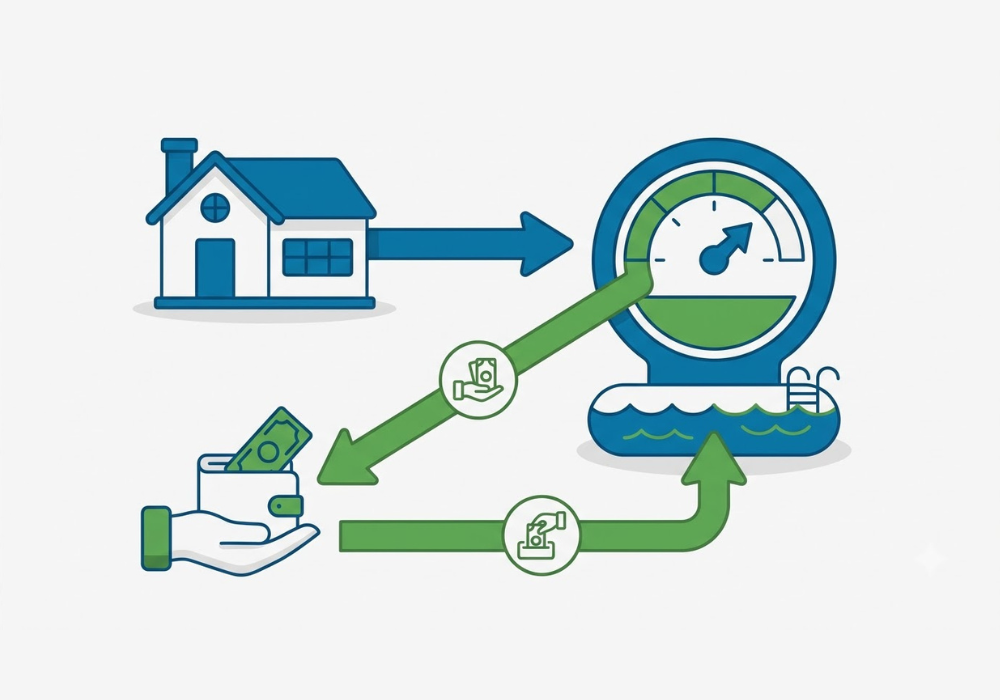
Most HELOCs have two phases. During the draw period, typically about 10 years, you can pull funds as needed and often make interest-only payments on what you have borrowed. After that comes the repayment period, often up to 20 years, when you can no longer draw and you repay the principal plus interest. You are approved for a credit line usually equal to 80% to 90% of your home’s value minus your mortgage balance, and you only pay interest on the amount you actually draw.
Most HELOCs carry variable interest rates that move with the prime rate, though some lenders offer a fixed-rate conversion option. This flexibility makes HELOCs popular for home improvements, debt consolidation, and other large or ongoing expenses.
Current HELOC rates in 2026
HELOC rates have eased over the past year. A competitive HELOC rate in 2026 generally falls between about 7% and 8.5% APR, with the national average sitting around 7.5% to 7.9%. That is down from roughly 8.3% a year earlier, reflecting the Federal Reserve’s rate cuts, and the best-qualified borrowers can find rates lower still.
Because HELOC rates are variable and tied to the prime rate, your individual rate depends on several factors: your credit score, your loan-to-value ratio, how much you draw, and your debt-to-income ratio. A borrower with a high credit score and low LTV will see a much better offer than someone borrowing near the limit with fair credit. Watch for introductory rates too, since some lenders offer a low fixed rate for the first several months before switching to a higher variable rate.
A notable 2026 tax change for HELOCs
There is a meaningful update for HELOC borrowers this year. Reports indicate that beginning with the 2026 tax year, HELOC interest may be deductible up to a set dollar limit regardless of how you use the funds. That is a shift from the prior rule, which generally limited the deduction to money used to buy, build, or substantially improve the home securing the loan.
Because this is a recent change, do not assume it applies to your situation. Confirm the current rules, limits, and eligibility with the IRS or a qualified tax professional before counting on any deduction.
How to qualify for the best HELOC rate
Lenders reserve their lowest rates for the strongest applicants. To position yourself well:
- Build enough equity. Most lenders let you borrow up to 80% to 85% of your home’s value minus your mortgage, so you generally need at least 15% to 20% equity. The more equity you keep, the better your rate.
- Strengthen your credit. Scores above 740 tend to earn the best offers, and some lenders accept a minimum around 620 at higher rates.
- Keep your debt-to-income ratio low. Lenders compare your monthly debt payments with your income, and a lower ratio helps.
- Shop multiple lenders. Rates and fees vary widely, so comparing several offers is the single most reliable way to find the lowest cost.
How to choose the best HELOC lender for you
The “best” lender depends on your priorities. Weigh these factors:
- Rate and fees. Compare the APR along with any origination, annual, or closing costs. A low rate with high fees may cost more than a slightly higher rate with none.
- Maximum combined loan-to-value. If you need to tap more equity, look for lenders allowing 90% or higher.
- Minimum credit score. Match the lender to your credit profile.
- Draw and repayment terms. Check the draw period length and whether interest-only payments are allowed.
- Fixed-rate option. If variable rates worry you, prioritize lenders offering a fixed-rate conversion.
- Funding speed. Online lenders often fund faster than banks or credit unions.
- State availability and service. Confirm the lender operates in your state and check customer-satisfaction ratings.
HELOC vs. home equity loan vs. cash-out refinance
A HELOC is one of three main ways to tap home equity. Here is how they compare.
| Option | How it works | Best for |
|---|---|---|
| HELOC | Revolving credit line you draw from as needed, usually variable rate | Ongoing or uncertain expenses where you want flexibility |
| Home equity loan | Lump sum at a fixed rate, repaid on a set schedule | A one-time expense with a known cost |
| Cash-out refinance | Replaces your mortgage with a larger one and gives you the difference in cash | Tapping equity while potentially changing your primary mortgage rate |
If you have a known, one-time cost, a fixed-rate home equity loan may suit you better. If you want to draw funds over time, a HELOC’s flexibility wins.
HELOC pros and cons
The upside:
- Flexible access to cash, drawing only what you need.
- Often lower rates than credit cards or personal loans, since it is secured by your home.
- Interest-only payments are frequently available during the draw period.
- Potential tax deductibility, subject to the current rules.
The risks:
- Your home is collateral, so defaulting can put it at risk.
- Variable rates mean your payment can rise.
- Easy access can tempt overborrowing.
- Closing the loan or reaching the repayment period can bring a payment jump.
How to apply for a HELOC
- Estimate your equity. Subtract your mortgage balance from your home’s value to gauge how much you can borrow.
- Check your credit and finances. Know your score and debt-to-income ratio before applying.
- Compare several lenders. Use the criteria above to weigh rate, fees, LTV, and terms across at least three lenders.
- Apply and provide documents. Expect to submit income verification, and an appraisal is often required.
- Review terms and close. Confirm the rate structure, fees, draw period, and repayment terms before signing.
Frequently asked questions
Who are the best HELOC lenders in 2026?
Lenders frequently ranked among the best include Truist for overall flexibility, Figure for fast online funding, Navy Federal for military members, Bethpage for no closing costs, Better for higher loan-to-value, and Bank of America for big-bank relationship perks. The best choice depends on your credit, equity, and priorities.
What is a good HELOC rate in 2026?
A competitive HELOC rate generally falls between about 7% and 8.5% APR, with the national average near 7.5% to 7.9%, down from a year earlier. The best-qualified borrowers can find lower rates, and your rate depends on your credit, loan-to-value ratio, and lender.
How much can I borrow with a HELOC?
Most lenders let you borrow up to about 80% to 90% of your home’s value minus your mortgage balance, so you typically need at least 15% to 20% equity. Some lenders, like Navy Federal for eligible members, allow up to 95%.
What credit score do I need for a HELOC?
The best rates usually go to scores above 740, but some lenders approve HELOCs with a minimum around 620 at higher rates. Your loan-to-value ratio and debt-to-income ratio also affect approval and pricing.
Is HELOC interest tax deductible?
Reports indicate that starting with the 2026 tax year, HELOC interest may be deductible up to a dollar limit regardless of how you use the funds, a change from prior rules. Because this is recent, confirm the current rules with the IRS or a tax professional before relying on a deduction.
Is a HELOC better than a home equity loan?
It depends on your need. A HELOC offers flexible, revolving access and usually a variable rate, which suits ongoing expenses. A home equity loan gives you a fixed-rate lump sum, which suits a one-time cost with a known price.
How fast can I get a HELOC?
It varies by lender. Online lenders like Figure can fund in as little as about five days, while traditional banks and credit unions may take several weeks, partly because an appraisal is often required.
This article is for educational purposes only and is not financial, lending, or tax advice, and it is not an endorsement of any lender. Rates, fees, terms, availability, and tax rules vary by lender and state and change frequently. A HELOC is secured by your home, which is at risk if you cannot repay. Verify current terms directly with lenders, compare multiple offers, and consult a licensed financial or tax professional before borrowing.
